I must standardly begin this analysis of the Da Vinci Classics recording—featuring chamber music compositions by Giorgio Federico Ghedini for violin, cello, and piano performed by the Trio Vasari—by contradicting the claim made by Flavio Menardi Noguera in the liner notes: namely, that this Piedmontese composer (born in Cuneo in 1892 and died in Nervi in 1965) has finally been granted his rightful merit and due notoriety, at least regarding his major works, which have also been made available on record. While it is true that this author’s name and a portion of his output are known and appreciated, this appreciation remains confined within a mathematical "subset," as it were, made up of enthusiasts of early 20th-century Italian music and the usual "insiders." The path leading to the general public remains perilous and heavily obstructed.
Yet, this is nothing new. There are still several Italian composers active since the dawn of the twentieth century who, despite being known by name, are still waiting not so much for a fruitful, in-depth study, but at least for a rudimentary familiarity in terms of listening and assimilating their sonic thought. To make a quick assessment, we need only look at figures like Vittorio Rieti, Renzo Bossi, Vincenzo Tommasini, or Adone Zecchi as simple examples. Therefore, I believe that Luciano Berio's judgment—Berio was, among other things, a student of Ghedini's—placed at the very beginning of the CD booklet, which states verbatim: "Ghedini was a great musician, uncomfortable and solitary. I think that the history of Italian music will soon need him, and he can therefore be placed in a fair and, in some respects, new perspective," must still be considered a wish waiting to be fully realized. After all, that Ghedini was an uncomfortable and moreover solitary figure is sacrosanctly true, and this certainly did not help him in a (musical) world where sycophants and conformists are never in short supply. However, it is equally true that his music, alongside his creative and aesthetic choices, demands a type of listening and metabolization that is utterly repelled by today's "hit-and-run" culture. Ghedini must not just be listened to; above all, he must be understood. And therein lies the problem, even if we are finally aided by recording projects like the one at hand, as his vast catalogue is beginning to be sifted through, and no longer solely in the name of his "major works."
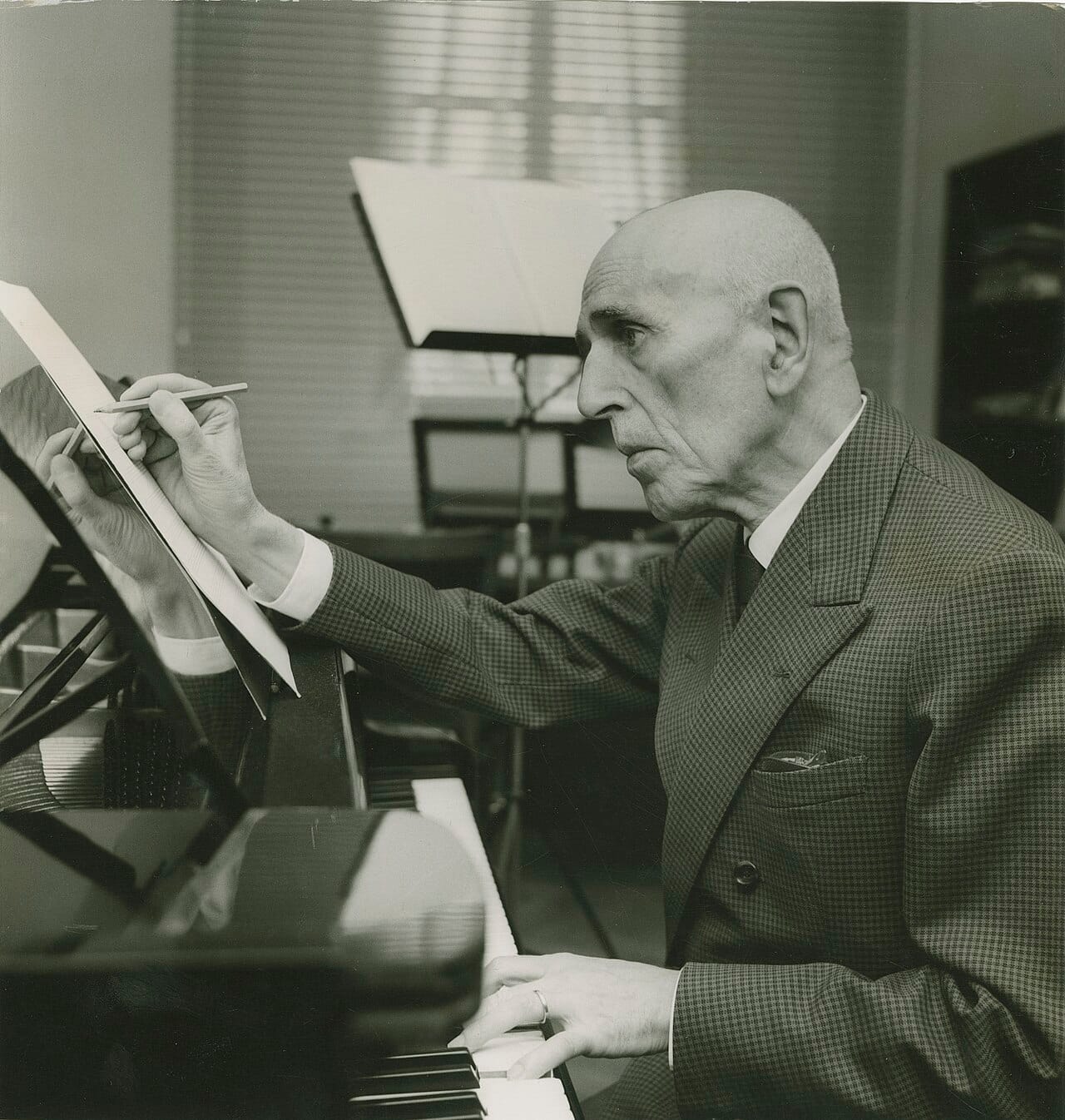
An uncompromising, independent author, inclined toward an attitude of intellectual defiance to safeguard his artistic and cultural integrity, Ghedini was the quintessential son of the Piedmontese land—a region that imposes the law of speaking little and doing much. He was always fully conscious of forging a path built upon a level of work that was nothing short of unimaginable. Besides being a composer and conductor, he was also a highly accomplished teacher at major conservatories, such as those in Turin, Milan, and Parma, to say nothing of his côté as a curious and passionate ethnomusicologist who, following in Bartók’s footsteps, rediscovered and reworked folk songs from Northern Italy. In return for this, he received little recognition and, above all, a notoriety reduced to a larval state, even though his scores were conducted by the greats of the era, such as Victor De Sabata, Herbert von Karajan, Sergiu Celibidache, Carlo Maria Giulini, and Guido Cantelli.
If anything, I fully agree with the author of the booklet notes when he states that, in the name of his own expressive freedom, Ghedini not only refused to adhere to any school (another reason that led to his marginalization by the narrow-minded Italian musical establishment) but was also the architect of a fundamental revival of all those composers, especially Italian ones, who belonged to the heart of the Renaissance and the nascent Baroque. This was a trait he shared on one hand with Respighi and on the other with Maderna, given that these two composers were equally sensitive, like him, to the immense lesson of the music of a distant past, albeit based on opposing intentions and agendas. Furthermore, another great merit of our Piedmontese composer is that, to his and our fortune, he remained immune to the harmful virus of “belcanto” and the plague of “operismo” tout court, which had claimed so many victims over the course of the previous two centuries, effectively atrophying a potential relationship with the progressive development of instrumental music taking place across the rest of Europe.
Thus, walking in the footsteps of revered figures such as Andrea and Giovanni Gabrieli, Claudio Monteverdi, Girolamo Frescobaldi, Heinrich Schütz, Antonio Vivaldi, and Johann Sebastian Bach, Ghedini succeeded in forging a compositional vision where technique and expression, structure and its rightful extension, and a sense of harmony capable of never compromising the melodic impulse, had to coexist. Upon closer inspection, there is a precise common thread that unites nearly all of these model composers despite their stylistic differences: namely, what can be defined as a "formal nobility," which Ghedini reinterpreted through the language and colour of the twentieth century.
These choices—alongside his absolute desire for independence and his refusal to align with any "ideological" identification in the music of his time—came at a heavy price for our composer. This became especially clear when the post-Webernian avant-gardes that germinated in Italy presented him with the bill, labelling him a sort of "Carlo Cassola of sound." This echoed what the members of the Gruppo '63 did during those same years to the Roman writer, whom they literally dismissed as a modern-day "Liala."
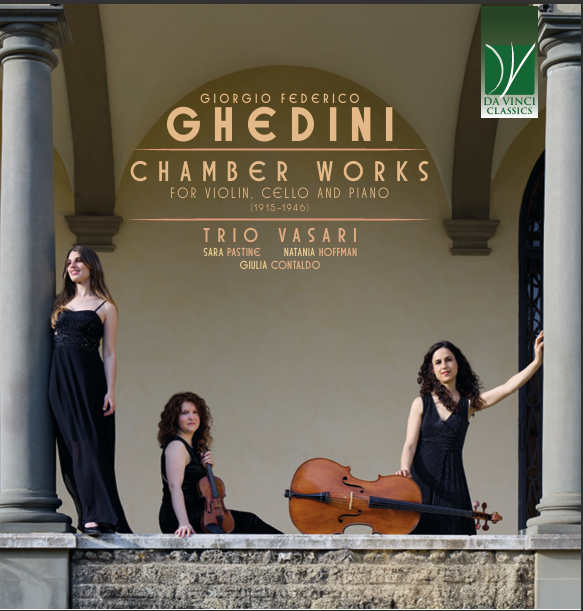
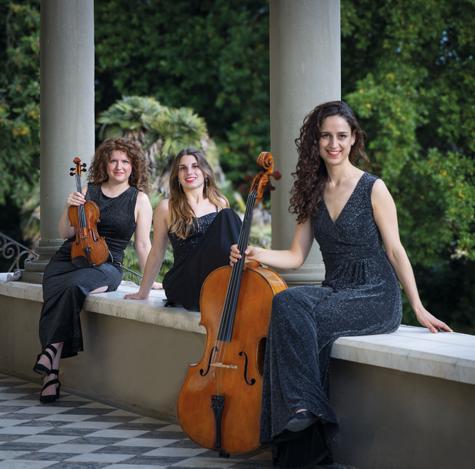
If Ghedini’s name is remembered today, it is chiefly due to his orchestral and concertante corpus—starting with the celebrated Concerto dell’Albatro from 1945—yet his chamber output must not be overlooked. This is precisely the premise taken by the Trio Vasari (Sara Pastine on violin, Natania Hoffman on cello, and Giulia Contaldo on piano), whose recording features five works dedicated to these three instruments. In chronological order, these are: Due intermezzi for violin, cello, and piano (1915), Elegia for cello and piano (1923), Elegia drammatica for violin and piano (1930), Sette Ricercari for violin, cello, and piano (1943), and Canoni for violin and cello (1946). These compositions span just over three decades, ideally tracing the work in progress of the musical material shaped by the Piedmontese composer, a material thoroughly infused with the DNA of his creativity and sensibility.
Contrary to the album's actual playlist, I prefer to follow this strict chronological order to better highlight this evolutionary work in progress. With the Due intermezzi for violin, cello, and piano, we find a twenty-three-year-old Ghedini grappling with the final remnants of a Late-Romanticism glimpsed from across the Alps, drawing from it thematic cells and structural frameworks. He does so in two diametrically opposed ways, as evidenced by the two intermezzi in question, the Tranquillo and the Bizzaria [sic]. While the former clearly reflects an approach where the timbral qualities of the three instruments are shaped along both horizontal (unison) and vertical (counterpoint) axes, giving rise to an almost dreamlike dimension—the atmosphere is nearly Debussian, even if the structural core yields a different result—the subsequent piece takes on characteristics that are virtually unique within his output. Here, we are effectively faced with a "Humoresque," a deliberately askew score dominated from start to finish by precise sonic effects (dissonances, glissandi, pizzicatos, acciaccaturas). It almost gives the impression that Ghedini wished to try his hand at a study in mastering sonic matter pushed to its extremes—an exercise in bravura and absolute technique steeped in ironic, sardonic, and even mocking elements.
Through his first rudiments in the study of musical language, the very young Ghedini also had the opportunity to study the cello in Turin. This instrument remained etched in his heart and in his nature as a shadowy man, existentially inclined toward the lower-middle register. Therefore, it is entirely unsurprising that he later dedicated several works to this bowed instrument, both in orchestral and chamber settings—as is the case with the Elegia, which follows the Due Intermezzi by eight years and was dedicated to the sublime cellist Livio Boni. Although composed in 1923, this piece looks more to the past than to the present of its time, as we are still within a Romantic atmosphere of a salon-like character. Ergo, his foot is pressed firmly down on the accelerator of lyricism, though this is not necessarily linked to the human voice. If anything, it represents a continuous exploitation of the instrument's technical capabilities without ever casting aside the prevailing melodic dynamics, while the piano, tucked away in a corner apart from a few moments of blossoming prominence, remains to act as a faithful guardian.
Seven years later, in 1930, Ghedini composed the Elegia drammatica for violin and piano. One must not be misled by the French indications provided in the score—namely, "douloureux et intimement expressif", "très soutenu et douloureux", and "désespérément"—as there are no transalpine influences to be found. Here, we are faced with a mature composer, fully conscious of channelling a language in which his personal imprint is increasingly marked and original. The first observation lies in hearing how there is no search for a balance between the two instruments; the bowed instrument tends to dominate, especially in the élans launched into the surrounding space by resorting primarily to high-register textures, striking the composition in the name of the very drama highlighted in the title. Its duration barely exceeds five minutes, yet the density of the score is remarkable, with the piano tasked not with merely accompanying, but with alternating the sonic matter—precisely in the name of that originality the composer already had in his sights. This originality also manifests in the final measures, when the sound literally tends to vanish, evaporating with melancholy and "painfully."
Without a doubt, the centrepiece of this recording is offered by the Sette ricercari for violin, cello, and piano. Conceived during the Second World War, they provide striking evidence of the Cuneo-born composer’s profound interest in forms and genres belonging to early music. In this instance, we are dealing with the Ricercare genre, which was specifically cultivated in Italy between the sixteenth and seventeenth centuries. Given its inherent characteristics—devoted precisely to a "seeking out" (ricercare) of new stylistic and technical possibilities within sonic language—it became a source of creative nourishment for Ghedini and for those other early twentieth-century musicians responsive to the call of a distant past. And this is exactly what the composer achieves in this work: its "search" for a supreme stylistic order, for a technical perfection driven by counterpoint, reveals the desperate need of an artist with Ghedini's sensitivity for an existential order, for a blueprint of vital harmony in the very midst of a war destined to obliterate a large part of Western civilization. Ghedini dedicated this score to Dario De Rosa, the pianist of the Trio di Trieste—an ensemble that was nothing short of legendary in the history of chamber music interpretation.
Listening to how they unfold, one better understands the reason for this dedication and the implicit demand to have this composition performed by an exceptionally reliable trio. We are standing before one of the pinnacles of early twentieth-century chamber music, a monument to the concept of abstract music based on technical rigor and formal exaltation (as an example, one need only recall that the theme of the seventh ricercare is constructed using the letters, according to German nomenclature, of the first and last names of the Trio di Trieste's members). It is an icon of mastery over sonic matter, in which the radiating nobility of the construct never loses sight of the expressive impulse, proclaimed either individually or chorally by the three instruments (at times, one senses the "percussive" lesson of Béla Bartók, though this is never exploited tout court as a merely derivative or imitative element). The rhythmic instability governing the entire compositional arc is the litmus test that carves out the tragedy of that historical moment, distilled through creative mastery—an impressive and moving portrait of Ghedini’s state of mind, offering his artistic testimony as a flickering flame of hope in a present that was desperate to say the least.
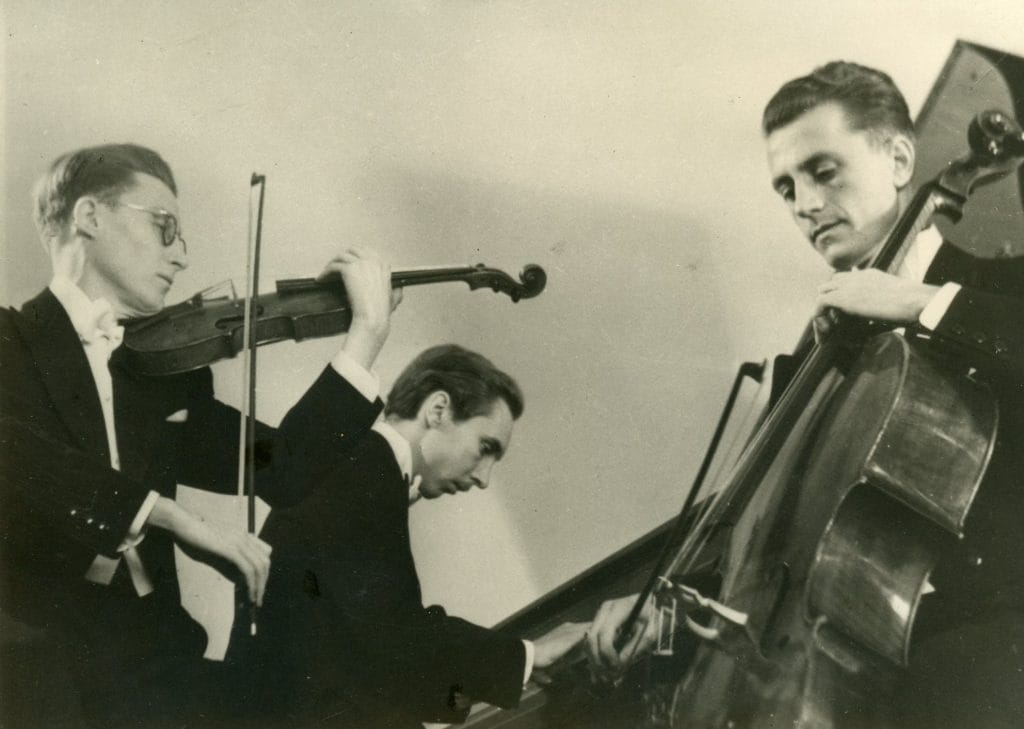
The exacerbation of the technical element reemerges in the final piece of this recording: the Due canoni for violin and cello, dating back to 1946. At this time Ghedini, intrigued, so to speak, by serialism, transformed it into yet another tool of research to enrich his creative necessity. Here again, entrusting the work to Libero Lana and Renato Zanettovich—respectively the cellist and violinist of the Trio di Trieste—speaks volumes about how perilous and fraught with performance obstacles these two pieces are. (Flavio Menardi Noguera recalls in the liner notes that their complete repetition was required at the end of the world premiere just to help the audience understand them). If we must use the term "tool" to clarify the Cuneo-born composer's use of twelve-tone technique in this piece, it is because his application of this language is entirely personal, subjective, and detached from orthodox Schoenbergian rigor; it is shaped by the will of its author, who injects stabilizing chords that tend to soothe the logical exacerbation of the language itself. This is highlighted especially in the second Canone, where the biting roundness of its unfolding—aided by an obsessive pizzicato—tends to smooth over the linguistic density, as if wanting to indulge in a nostalgic rhythmicity that vanishes into thin air, into a sudden silence, a signature stylistic trait of our author.
From what has been outlined, it seems obvious that, on an interpretative level, presenting Ghedini’s music demands that two factors be absolutely satisfied: on one hand, knowing how to technically render this "formal nobility"; on the other, not sacrificing the expressiveness that permeates his compositions. Such qualities are usually found in performers whose maturity—even in terms of age—is already consolidated regarding style and depth of study. In this case, by contrast, it is striking that the three artists in question are still quite young, yet this does not imply a lack of those characteristics so fundamental to performing the musical universe of the Cuneo-born composer. On the contrary, listening to their readings again reveals a stylistic depth underpinned by rock-solid technical foundations (to put it plainly, if the technique is not ironclad, Ghedini’s music becomes unplayable), as well as the capacity to express—that is, to draw out from the score—the plethora of intentions, nuances, and sudden shifts indispensable for exalting those abstract features at the core of his musical vision. Furthermore, we must not forget another aspect: the rapport they have managed to demonstrate, their collective breath, and their ability to blend their sound while still distinguishing the individual qualities of each instrument (a quality that must never be lacking when a composition thrives on counterpoint). Additionally, this album represents their recording debut, which is undoubtedly an added value. Chapeau!
The sound engineering, captured by Antonio Verderi, is well-crafted; the dynamics are bolstered by an unquestionable energy, while demonstrating fast transient response and a more than respectable naturalness. The soundstage parameter reconstructs the three performers and their instruments at the centre of the sonic space, characterized by an acceptable depth, with the sound radiating in width and height with an appreciable focus. The tonal balance presents no flaws whatsoever: the registers of the three instruments are always identifiable and never become "muddy," even during passages that reach fff and ppp. Finally, the detail is pleasantly tactile, offering a precise three-dimensional projection of the instruments, which are well-defined against a more than sufficient backdrop of "blackness."
Andrea Bedetti
Giorgio Federico Ghedini – Chamber Music for violin, cello and piano (1915-1946)
Trio Vasari (Sara Pastine - violin, Natania Hoffman - cello, Giulia Contaldo - piano)
CD Da Vinci Classics C01162
Artistic rating 4,5/5
Technical rating 4/5