I fully agree with those who maintain that there is something almost paradoxical about the piano repertoire for the left hand alone. What originates in a limitation — real, physical, and sometimes traumatic (as in the case of Paul Wittgenstein, brother of the philosopher Ludwig) — ultimately turns into a challenge to perception: making the listener forget that bass lines, melody, accompaniment, inner voices, chords, and figuration are all being produced by a single hand. It is precisely around this paradox that For the Left Hand, the album recorded by William Grant Naboré for Da Vinci Classics, is conceived. The composers represented — Johann Sebastian Bach, Johannes Brahms, Carl Reinecke, Aleksandr Scriabin, and Leopold Godowsky — are not merely juxtaposed because of a shared instrumental affinity; rather, they seem to reveal five different ways of rethinking pianistic space through the “path of the left hand.”
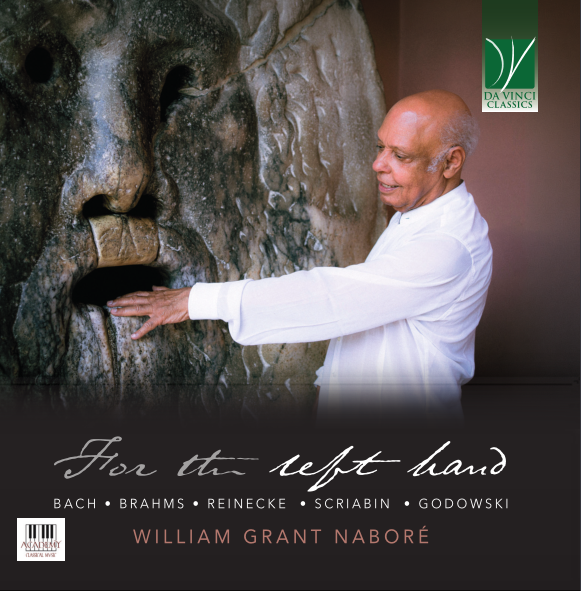
The inevitable focal point of the album is the Chaconne from Johann Sebastian Bach’s Partita No. 2, BWV 1004, in the version devised by Johannes Brahms. It is important to remember, as Naboré himself emphasizes in the accompanying notes, that Brahms did not really regard it as a “transcription,” but rather as a study for the left hand based on Bach’s Chaconne. This distinction, it should be stressed, is not merely terminological. By restricting himself to the left hand alone, Brahms removes precisely that ease of distribution across the keyboard which a conventional piano transcription might have exploited, thereby forcing the performer to reconstruct, with a single limb, the illusion of polyphony and, at the same time, something of the physical tension inherent in the violin original. It is significant that, in a letter to Clara Schumann in 1877, Brahms explained that the very difficult imposed by the left hand — arising from the nature of the arpeggios and from the impossibility of relying on the customary procedures of two-handed piano writing — gave him the sensation of “feeling like a violinist.” It is therefore no coincidence that Naboré places this work at the very opening of the album and, with its roughly sixteen-minute span, allows it to function as a true gateway to the entire programme. From this point onward, the left hand is no longer an exception or a technical curiosity: it becomes a compositional principle.
The relationship with Bach is very different in the Gavotte en Rondeau from the Partita in E major, BWV 1006, presented here in the transcription by the Hungarian pianist and pedagogue Rafael Joseffy. Bach himself had transferred the Partita into the realm of the lute, thereby producing the Suite BWV 1006a; Joseffy, a pupil of Liszt, prepared in 1888 the piano version used in this recording. If Brahms’s Chaconne is a meditation on the possibility of reinventing Bach through technical constraint, Joseffy stands more directly within the nineteenth-century tradition of transcription: the challenge here is to condense onto the piano the rhythmic clarity, the pulse of the dance, and the distribution of the lines without distorting the character of the original.
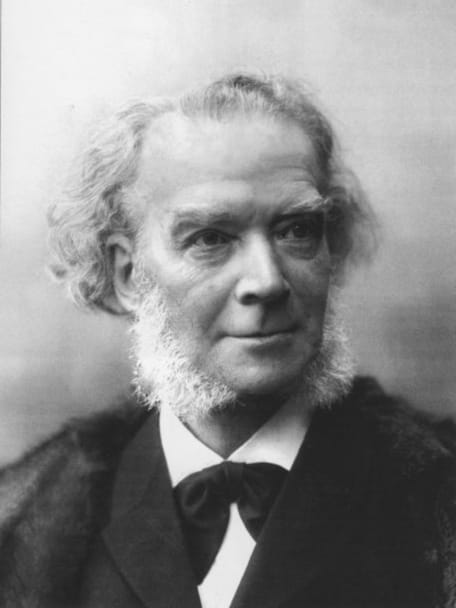
The real discovery of the programme, at least from the point of view of repertoire, is Carl Reinecke’s Sonata in C minor, Op. 179. Composed in 1884, it forms the architectural centre of the album and is also the work that most decisively removes left-hand literature from the realm of the étude, the character piece, or the virtuoso exercise. Here, by contrast, we have a four-movement sonata fully conceived within the Romantic tradition. Reinecke, a figure heard far less frequently today than his historical position would suggest, was a highly influential pianist, composer, and teacher in Leipzig, and among his pupils were Edvard Grieg, Leoš Janáček, and Isaac Albéniz. The opening Allegro moderato immediately establishes a broad, dramatic style of writing in which the limitation of the hand in no way entails a restriction of harmonic thought. The Andante lento, built on the Hungarian folk melody Ne menj rózsám a tarlóra, introduces instead a lyrical and almost elegiac dimension; the ensuing Menuetto moderato in fact abandons much of the eighteenth-century poise suggested by its title and approaches, as Naboré rightly observes, a kind of Valse-Caprice; finally, the Finale. Allegro molto concentrates the writing in the direction of a brilliant, dense, and openly concertante virtuosity.
Reinecke’s Sonata is important also because it shows how the problem of the left hand can be approached not “against” the instrument, but by starting from its own specific possibilities. The wide lateral movements, the extremely rapid alternation of registers, and the need to allow the melody to emerge from a texture created by the very same hand are not merely difficulties to be overcome; they become generative elements of the form itself. This is probably one of the most fascinating aspects of the entire album: anatomical restriction ends up, almost miraculously, creating a different pianistic syntax.
With the Prélude and Nocturne, Op. 9, by Aleksandr Scriabin, the discussion inevitably takes on a biographical dimension. In 1892, at the age of twenty, the composer developed a serious problem with his right hand as a consequence of obsessively practising such formidable works as Liszt’s Réminiscences de Don Juan and Balakirev’s Islamey; two years later came the two pieces of Op. 9 for the left hand alone. We are still far removed from the visionary and harmonically corrosive Scriabin of the later works, since here the influence of Chopin remains evident, above all in the shaping of the melodic line and in the continuity of the pianistic gesture. And yet the composer’s personality is already recognizable in the harmonic instability, the attraction towards suspended sonorities, and the transformation of the texture into a kind of continuous breathing. The Nocturne in particular raises one of the essential problems of the entire left-hand repertoire: persuading the ear of the simultaneous existence of different planes when, physically, they are produced in succession. This is therefore not merely a matter of virtuosity, but of an art of temporal illusion.
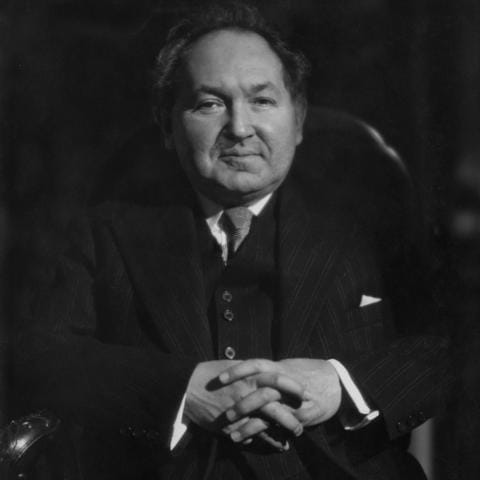
The journey closes with Leopold Godowsky, probably the composer who explored the potential of the left hand more systematically than anyone else. It is no coincidence that he was known as the King of the Left Hand, while the extraordinary complexity of his piano writing remains legendary. Naboré, however, chooses two works that reveal almost opposite sides of his personality: the Elegy for the Left Hand of 1929 and the Prelude on the name of BACH. The Elegy demonstrates how reductive it is to identify Godowsky solely with the hyper-virtuosity of his celebrated reworkings of Chopin’s Études. Here, technical complexity is absorbed into an introspective discourse in which the density of the writing serves above all an expressive function. The Prelude on BACH, by contrast, brings the album back towards a more openly virtuosic dimension and, at the same time, ideally closes the circle begun with the Chaconne: Bach is not merely the first composer represented in the programme, but a presence that runs through and seems to hover over the entire project. It is hardly surprising that Naboré dedicates the album to him, significantly calling him “the father of us all.”
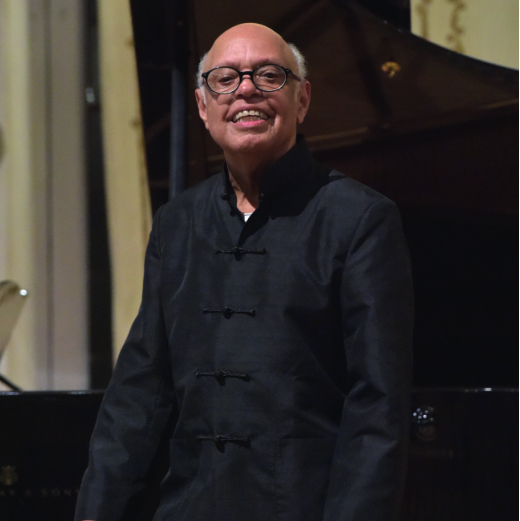
The figure of the performer himself also contributes to giving this project its particular significance. Born in 1941, William Grant Naboré received a training that brought him into contact with very different pianistic traditions: Carlo Zecchi and Renata Borgatti in Rome, followed by Denise Lassimonne, Alicia de Larrocha, Rudolf Serkin, and other distinguished teachers. Above all, however, his teaching activity has made him a central figure in international piano education, first through the Theo Lieven International Piano Foundation and later through the International Piano Academy Lake Como.
For the Left Hand thus takes on the character of an almost pedagogical project, in the highest sense of the term. It is neither a display of bravura nor an anthology of rarities, but rather an investigation into what happens when the piano is deprived of half of its apparent performing resources and, precisely for that reason, is forced to reinvent itself. From Brahms to Godowsky, by way of Reinecke’s unexpected formal breadth and Scriabin’s youthful sensitivity, the left hand ceases to be a limitation and becomes a different way of conceiving the instrument. The greatest merit of the programme devised by Naboré lies precisely here: in reminding us that virtuosity, when it is genuinely musical, does not consist in the accumulation of difficulties, but in the ability to make them invisible, transforming them into form, phrasing, and sonic imagination.
The sound recording, engineered by Giovanni Caruso, is acceptable overall. The dynamics are sufficiently energetic and responsive, although the result is slightly lacking in naturalness, with the piano tone in the upper register at times sounding metallic and somewhat saturated, perhaps as a consequence of rather close microphone placement. In terms of soundstage reconstruction, the instrument is presented at fairly close range — again, probably as a result of the microphone setup — although the perspective does not come across as unnatural. The tonal balance is reasonably successful, with sufficient differentiation between the treble and the middle-low registers. Detail retrieval is also quite satisfactory: although there is not an abundance of “blackness” surrounding the piano, the recording still manages to project a three-dimensional image of the instrument.
Andrea Bedetti
Various Composers – For the Left Hand
William Grant Naboré (piano)
Da Vinci Classics CD C01226
Giudizio artistico 4,5/5
Giudizio tecnico 3,5/5