Album of July 2026
The more we come to know it, the more we realize that the history of music is a construct as grand as it is imperfect. For over two centuries, we have been accustomed to traversing it as if it were a main highway along which a few names—always the same ones—succeed one another with apparent inevitability, destined to represent entire eras: Claudio Monteverdi, Arcangelo Corelli, Antonio Vivaldi, Johann Sebastian Bach. It is a reassuring narrative, offering the illusion of a linear order and a hierarchy based exclusively on merit.
And yet, one need only look more closely into the folds of tradition to realize that reality is far more complex. This is because cultural memory never coincides perfectly with artistic quality; rather, it is the product of a web of historical, editorial, political, and even biographical circumstances that have often impacted the fate of works as much as, and sometimes more than, their actual value. Thus, as each era consecrates its protagonists, it inevitably produces its excluded ones—entire catalogues that disappear, manuscripts that remain buried in archives, and composers celebrated by their contemporaries who are forgotten by subsequent generations. This is not a marginal phenomenon, but a constant in the history of art, and not only in music. The canon, by its very nature, simplifies it illuminates certain figures while leaving others in the shadows. For this reason, every genuine rediscovery possesses a value that goes beyond specialist interest; it not only restores a lost music but forces us to reconsider the very way in which we tell the story of the past.
In this respect, Ignazio Albertini belongs precisely to this category of authors. For a long time, his name survived almost exclusively in the footnotes of scholars studying the Austro-Italian violin school of the late seventeenth century. Scant biographical details, a violent death shrouded in uncertainty (so much so as to turn him into a sort of "musical Caravaggio"), and a single collection that has come down to us: these elements were sufficient, at least on the surface, to relegate him to those figures whom historiography all too casually defines as "minor." Yet in his case, this definition reveals all its fragility—not because Albertini ought to be artificially elevated to the rank of the great Baroque masters, but because his music demonstrates how arbitrary it is to equate renown with greatness. The posthumous publication of the twelve Sonatinæ Violino Solo, which took place in Vienna in 1692, represents one of the most fascinating episodes in seventeenth-century violin literature—an episode that bears witness to a musician who worked at the heart of the Habsburg court, in an environment where the most advanced developments of Italian culture and German tradition converged.
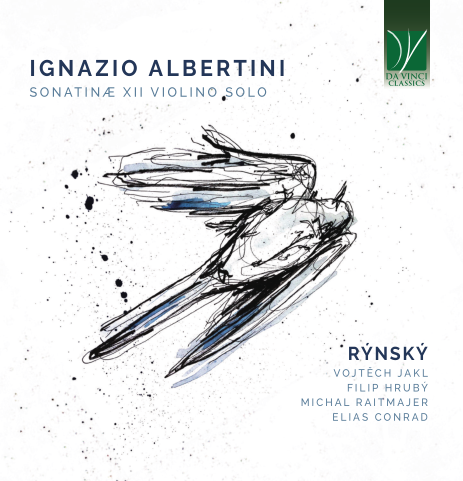
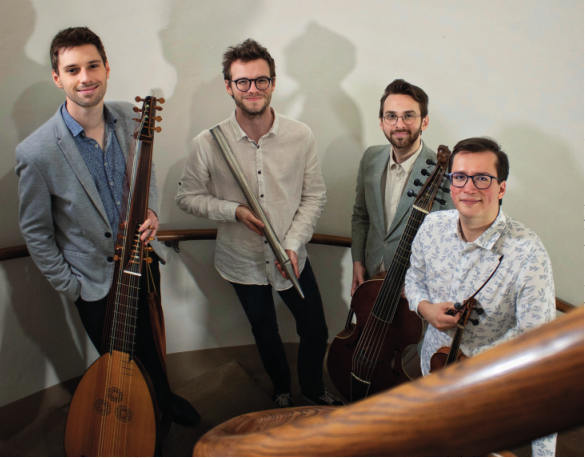
Now, fortunately for us—that is, for those who refuse to confine and entrench themselves strictly within the musicological and historical domain of the "usual names"—Da Vinci Classics has released a double CD containing the world premiere complete recording of the Sonatinæ, performed by the Czech-German ensemble Rýnský, featuring Vojtěch Jakl on violin, Filip Hrubý on organ and harpsichord, Michal Raitmajer on violone, and Elias Conrad on theorbo. The booklet accompanying this recording, written by Vojtěch Jakl, meticulously reconstructs what can be known today about Albertini's life and work, offering a portrait of a violinist who was esteemed by his contemporaries and embedded in one of the most vibrant and extraordinary musical laboratories of Baroque Europe. Yet it is only by listening to the entire cycle that the true significance of this crucial rediscovery is revealed: indeed, the Sonatinæ are neither an archaeological artifact meant solely for specialists nor a refined curiosity to be placed on the margins of the repertoire; rather, they bear witness to a decisive moment in the evolution of European instrumental music—namely, when the violin sonata was progressively emancipating itself from the experimental freedom of the early seventeenth century to adopt a firmer formal consciousness.
Albertini positions himself precisely on this threshold. Although his writing retains the unpredictable inventiveness of the great Italian masters, it simultaneously offers a glimpse of that structural tension that would become one of the most original hallmarks of the Austro-German school. This is likely the most striking aspect of his art. If the history of music teaches us that there are composers who invent a language and others who succeed in connecting different worlds, then Albertini belongs to the latter category. His music does not represent a simple encounter between two national traditions; rather, it constitutes the place in which different sensibilities merge into a new synthesis, endowed with an entirely personal voice. To understand it means to grasp just how much Baroque Europe was—far more than is commonly believed—a civilization of dialogue, exchange, and cross-fertilization.
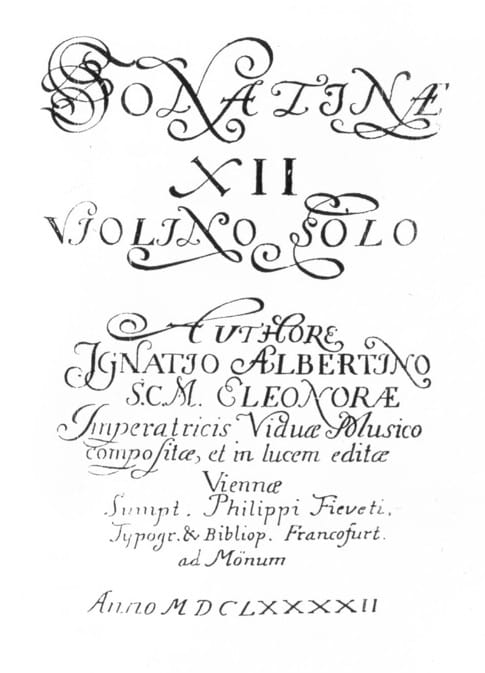
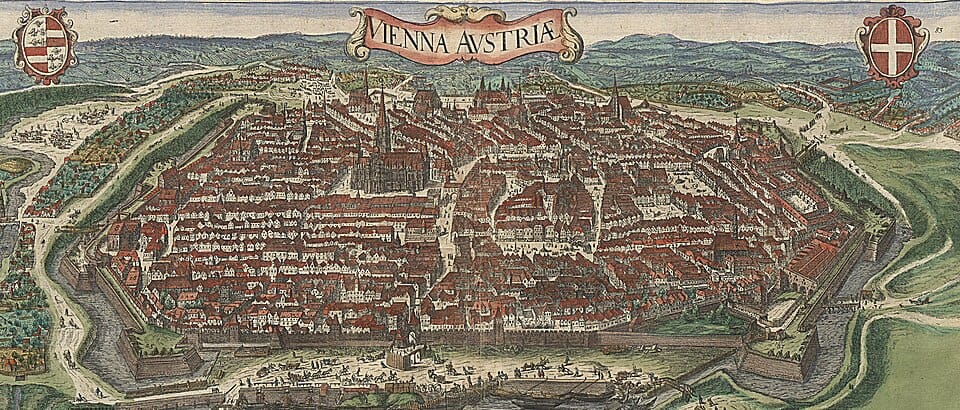
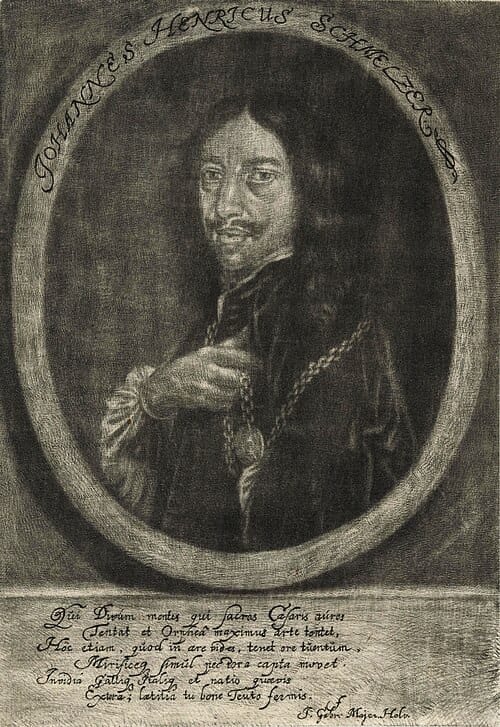
The Vienna in which Albertini worked was a city experiencing an unrepeatable era, to say the least. Capital of the Habsburg Empire, yet also a point of convergence for diverse cultures, in the second half of the seventeenth century it represented one of the most remarkable musical centres in Europe. Italian, German, Bohemian, and Austrian musicians converged there; the theatricality of the Venetian school intertwined with the rigor of the Germanic contrapuntal tradition and the aristocratic taste of a court that viewed music—thank goodness—not as a mere ornament, but as one of the privileged languages of power and representation. It was in this environment that the violin underwent a decisive transformation: from an instrument primarily employed in dance and accompaniment, it progressively became the protagonist of an autonomous repertoire, capable of exploring expressive possibilities that had hitherto been unthinkable. The generation of Johann Heinrich Schmelzer, to which Albertini belonged by training and cultural affinity, played a determining role in this evolution, which saw the violin cease to be merely a melodic instrument and transform into a true dramatic voice, capable of imitating song, suggesting theatrical gesture, and translating into sound that Affektenlehre which constitutes one of the foundations of Baroque aesthetics.
One should keep in mind that the Sonatinæ were born precisely within this horizon. They strike the listener first and foremost for the natural ease with which they manage to fuse two seemingly different worlds: on the one hand, one recognizes the Italian heritage—the freedom of fantasy, the taste for melodic line, and the continuously shifting invention that had found some of its most original exponents in Biagio Marini, Dario Castello, and Marco Uccellini; on the other, a different structural discipline emerges, a drive toward the unity of discourse that foreshadows the developments of the great Austro-German school. Yet Albertini—and herein lies his greatness—does not limit himself to juxtaposing one tradition alongside the other, as if they were two figures to be observed simultaneously; on the contrary, he assimilates both until they are transformed into a "personal language." It is precisely this autonomy that makes this composer, perhaps born in Milan in 1644, genuinely interesting—and not merely, as was previously believed, an intermediate link between Schmelzer and Biber, or a "peripheral reflection" of the Italian school. In reality, his Sonatinæ possess a character that cannot be reduced to any of these formulas, and their originality springs from a continuous tension between freedom and control, between improvisational invention and rigorous organization of musical thought.
Going into specifics, the first element that strikes the listener is the conception of form: nothing appears truly episodic. Every new idea seems to derive naturally from the preceding one, as though the musical discourse grew from within rather than proceeding by the simple juxtaposition of contrasting sections. From this, one can infer how such continuity imparts a striking narrative unity to the sonatas, given that—and this is precisely what I felt while listening to them—one receives the impression that the music is not constructed according to a predetermined scheme but progressively discovers its own direction as it unfolds. Albertini systematically avoids constructing through juxtaposed blocks, favouring instead a continuous evolution of the musical material, thereby allowing a melodic motif to generate a new figuration, a cadence to open up unexpected harmonic perspectives, or a brief pause to become an element of tension rather than a simple caesura. This is a quality that distinguishes the Sonatinæ from much contemporary violin production, which was often inclined to alternate contrasting episodes without the same narrative coherence. In Albertini, by contrast, the continuity of thought itself constitutes an expressive value: virtuosity, modulations, harmonic suspensions, and sudden melodic openings do not interrupt the flow of the discourse but rather represent its natural evolution.
It is here that the "rhetorical" matrix of our composer's writing emerges with clarity, for we must not forget that in the seventeenth century, the musician was considered, first and foremost, an orator—without any derogatory connotation attached to the term itself. Indeed, just as the classical orator arranged arguments to persuade the audience, so the composer organized the succession of affetti, tensions, and moments of repose so that the musical discourse would produce a precise effect on the listener. Albertini masters this concept with remarkable assurance, with pauses acquiring an expressive significance no less important than the most virtuosic figurations, and with modulations that seem to spring from an inner necessity; even the episodes of greatest technical brilliance carefully avoid turning into mere display. Furthermore, one must pay attention to how this rhetorical conception finds full alignment in the violin writing itself. The melodic line almost always avoids brilliance for its own sake, favouring instead a phrasing that seems modelled on the breath of the human voice; even in passages of greater technical demand, the instrument never loses its narrative function: the rapid figurations maintain a clear expressive direction, while double stops and chords are not used as a simple demonstration of skill, but rather as tools to intensify the discourse. This is why, in these pages, one can grasp a profoundly theatrical conception of the instrument. The violinist is called upon not to amaze the listener, but to persuade them—alternating momentum, contemplation, tension, and relaxation according to that "grammar of the affetti" which constitutes one of the foundations of Baroque musical culture. From this perspective, the Sonatinæ also surprise with the modernity of their harmonic writing. While remaining fully grounded in the style of his time, Albertini demonstrates a particular sensitivity to the expressive value of dissonance, chromaticism, and sudden tonal deviations—all creative devices through which the musical discourse gains psychological depth.
No less significant is the relationship with the continuo. In his liner notes, Vojtěch Jakl appropriately emphasizes that the continuo should not be considered a mere harmonic support, but rather a dialogic partner to the violin, called upon to participate fully in constructing the musical eloquence. This observation is to be fully shared, as it restores to these pages that dialogic dimension which constitutes one of the most refined features of the Baroque sonata. The further one delves into Albertini’s universe, the more evident it becomes that the long oblivion surrounding his name stems not from the quality of his music, but from the circumstances of its transmission. And it is precisely this realization that imparts to this recording a significance far exceeding the—nevertheless important—rediscovery of a forgotten repertoire; it invites us to critically reconsider the very idea of a "minor" composer, as I mentioned earlier, reminding us that, in the history of music, oblivion is often an accident of fortune rather than a reflection of artistic worth.
If the rediscovery of Ignazio Albertini represents an important musicological event in its own right, the value of this release resides above all in the quality of the cultural vision behind it (a hallmark that is right at home at Da Vinci). Classical discography today is experiencing a singular phase: never in recent decades have such sophisticated philological tools been available, yet never before has the market seemed so caught in a spiral of repeatedly reissuing the very same masterpieces. Bach's Sonatas and Partitas, Vivaldi's Four Seasons, and Corelli's Sonatas continue to generate new recordings—often excellent ones—while vast regions of Europe's heritage remain largely unexplored. The obvious risk is that discography may end up limiting itself to perfecting what we already know, abandoning its highest purpose: expanding our listening horizons. The complete recording of the Sonatinæ Violino Solo moves in precisely the opposite direction. It does not arise from the need to offer yet another reading of a universally recognized masterpiece, but from the desire to restore to the musical community a body of work that history had progressively pushed to the margins. In this sense, the album takes on the value of a genuine cultural restoration; it does not merely offer a new interpretation but reconstructs the conditions for a composer to finally be heard in his entirety.
Every recording of Bach or Mozart inevitably confronts a performance tradition that is endless, to say the least; by contrast, anyone approaching Albertini today finds themselves before a territory almost entirely devoid of established benchmarks, meaning the interpreter's responsibility increases exponentially. In the absence of an established performance tradition, artists are called upon to strike a delicate balance between historical fidelity and communicative power. Now, the strong temptation to accentuate the most spectacular aspects of the violin writing—turning Albertini into a pre-modern virtuoso—would likely have produced a captivating result, yet a decidedly misleading one. Equally limiting would have been an exclusively documentary reading, attentive to stylistic accuracy but incapable of conveying the internal dynamism of these pages. The interpretation given by the four formidable members of Ensemble Rýnský is instead one that privileges the continuity of the musical discourse. The various sections are conveyed not as self-contained episodes, but as moments within a unified expressive architecture in which phrasing, articulation, and agogic breath constantly contribute to the construction of musical meaning. In my view, this is a particularly compelling interpretive choice, as it restores to the Sonatinæ that narrative dimension which constitutes one of the most original aspects of their poetics.
For this very reason, this Da Vinci release is convincing above all due to the impression of coherence it manages to convey. Nothing appears left to fleet effect or the pursuit of originality for its own sake; on the contrary, the entire project seems to spring from profound reflection on the nature of this music, its historical position, and its innate expressive language. The result is an interpretation that avoids two opposite and equally insidious risks: that of turning Albertini into a mere exercise in sonic archaeology, and that of artificially updating him according to sensibilities foreign to his time. Instead, a wholly positive and constructive dimension emerges: a musicological and historical rigor placed entirely at the service of expression. Source research, familiarity with period instruments, and historical performance practice do not produce a coldly documentary outcome but rather nourish a reading in which the musical discourse retains all of its natural ease.
From this point of view, the role assigned to the continuo also reveals a particularly intelligent approach. For too long, it was treated as an almost invisible presence, confined to providing the necessary harmonic support for the development of the melodic line. The Sonatinæ, however, demonstrate just how reductive this perspective is. In this recording, the continuo actively participates in constructing the discourse, guiding its breath, dialoguing with the violin, gathering its impulses, and at times contradicting them—all in accordance with that fundamentally and properly theatrical conception of music that constitutes one of the hallmarks of Baroque culture.
Furthermore, the significance of this project lies in the fact that Albertini does not need to be proclaimed the "new Biber" or the "forgotten Bach" to justify the interest he excites today; rather, his importance springs from the intrinsic quality of his writing and from the position he occupies in a decisive phase of the violin sonata's evolution. Restoring this placement to him means making history richer and truer, not rewriting it arbitrarily. Ultimately, Albertini reminds us that there remains an immense musical geography still to be explored and that, at times, the most significant discoveries concern not unknown works, but the very way in which we are accustomed to viewing tradition.
For these reasons, the award of "Album of the Month" represents not merely an appreciation of an excellent recording but is intended as the natural recognition of a project that unites scholarly rigor, interpretive sensitivity, and genuine cultural vision. In a discographic landscape often dominated by the repetition of the most famous repertoires, a work like this reminds us that discovery is still possible, and that European Baroque holds treasures capable of speaking to the present with surprising force and unexpected modernity.
An additional element of interest lies in the excellence of the sound recording made by Gabriele Zanetti. The dynamics are extremely clean, crisp, and clear, marked by balanced energy and a speed capable of highlighting all instruments equally. Regarding the soundstage, it is worth pointing out that both excessive proximity—which would have ended up exaggerating every technical detail—and an overly generous reverberation—which would have tended to blur the contrapuntal design—were avoided. The resulting reconstruction within the sound space allows for a transparency particularly favourable to listening to a score in which the dialogue between the violin and the continuo represented a constituent element of the compositional thought. The quality of the tonal balance and detail follow naturally: the former brings extreme clarity, capable of offering the continuous play of weights and counterweights between the treble instrument and the mid-bass ones, enhanced by an excellently rendered separation of registers. The latter is exquisitely tactile, featuring a three-dimensional representation of the instruments that allows for an audition that never succumbs to fatigue.
Andrea Bedetti
Ignazio Albertini – Sonatinæ XII Violino Solo
Ensemble Rýnský
2CD Da Vinci Classics C01181
Artistic rating 5/5
Technical rating 5/5