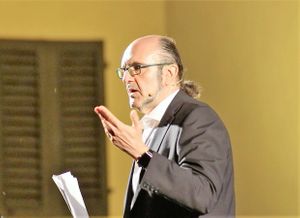
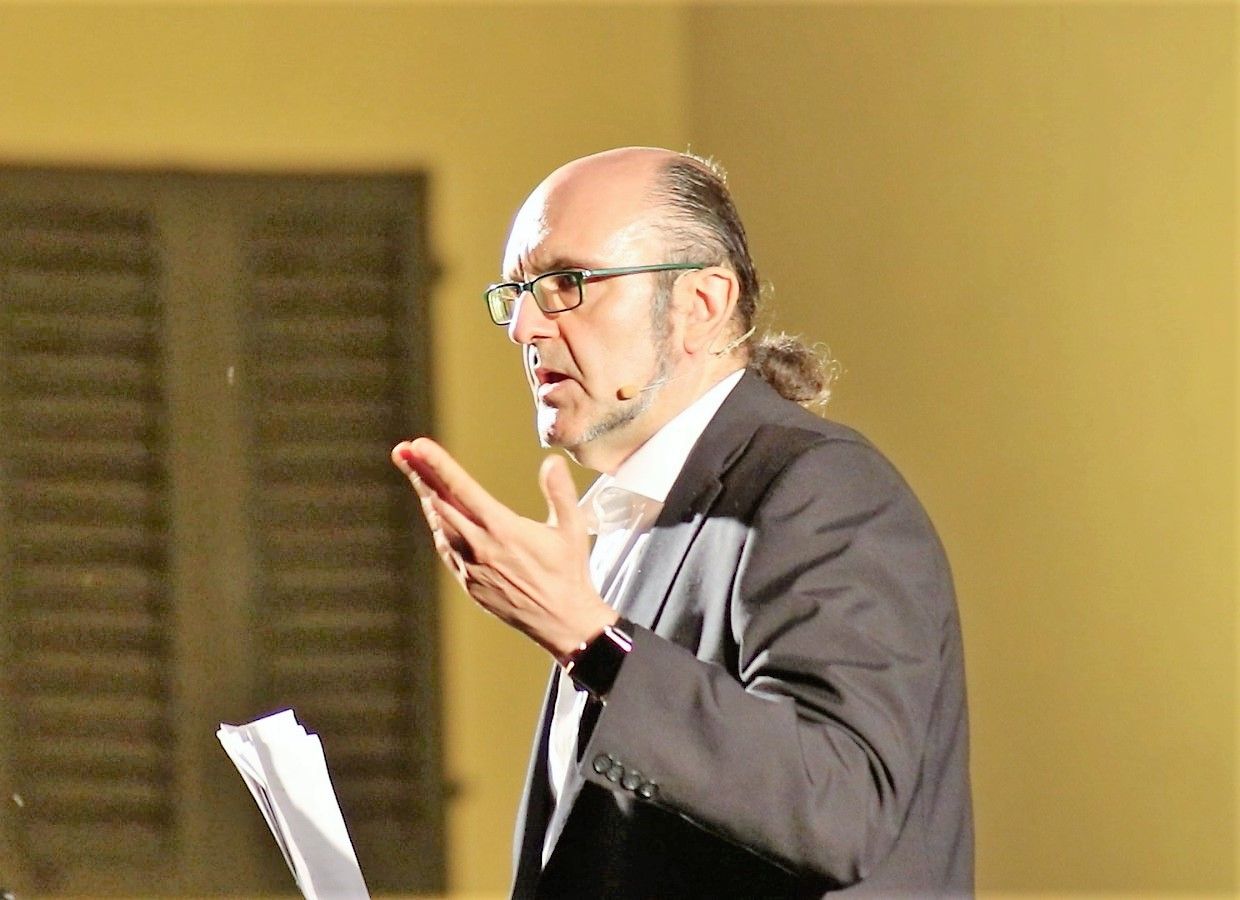
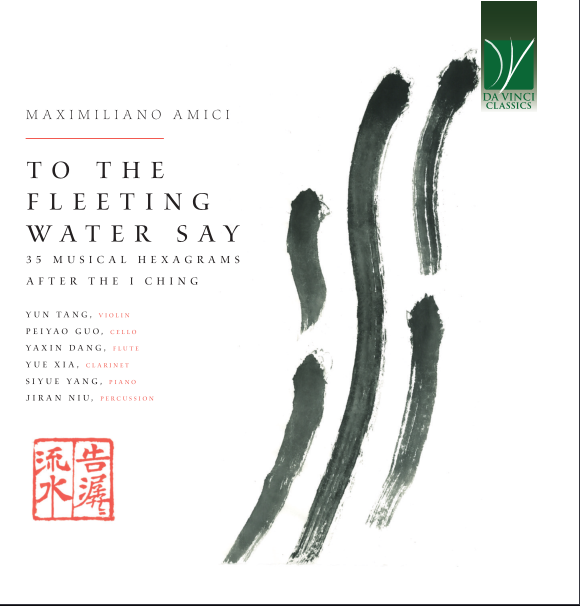
There is no doubt that a profound, almost ontological affinity exists between music and the concept of change: both unfold through time, both elude the fixity of matter, and both find their very raison d’être in an unceasing process of transformation. The moment a sound is produced, it begins to change, to dissolve, to make way for what will follow, since its very physical nature inevitably condemns it to perish as it fades away. And it is precisely in this transitory nature that we find one of the most fascinating possibilities for bringing Western musical thought into dialogue with the ancient Chinese wisdom of the I Ching, the compelling Book of Changes. This is precisely what the Italian composer Maximiliano Amici, born in 1980, has sought to achieve with his recent recording project, To the Fleeting Water Say. 35 Musical Hexagrams after the I Ching, released by Da Vinci Classics. In this collection, thirty-five instrumental miniatures explore the manifold manifestations of becoming, translating a complex philosophical and symbolic universe into a contemporary musical language.
To appreciate the distinctive nature of this undertaking, we must first consider the I Ching itself, one of the foundational texts of Chinese civilization, whose origins lie in divinatory practices developed in antiquity and subsequently enriched by successive layers of philosophical interpretation. Its symbolic system is based on sixty-four hexagrams, each consisting of six superimposed lines, either unbroken or broken, corresponding respectively to the principles of yang and yin. From the combination of these two polarities, understood not as irreconcilably opposed entities but as complementary and interdependent forces, emerges a dynamic representation of reality. The hexagrams do not depict absolute and permanent conditions; rather, they describe situations, relationships between opposing forces, possibilities of transformation, and particular moments within a process that knows no definitive stillness. Even when employed as an instrument of oracular consultation, the I Ching therefore invites reflection on the fragility of equilibrium and the need to recognize the movement that permeates every manifestation of existence.
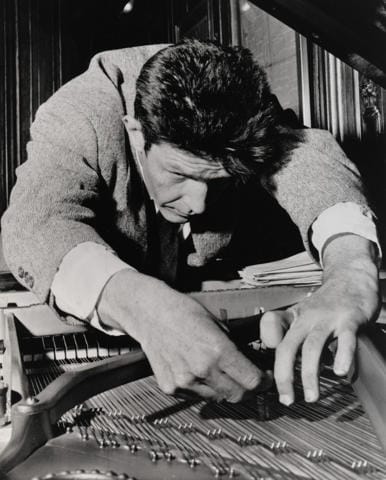
It would, however, be misleading to interpret Amici’s work as an experiment in translating divination into sound. In the preface to the recording, the composer makes it clear that he approached the I Ching primarily as a book of wisdom, deliberately rejecting the use of chance as an organizing principle. This is by no means an insignificant distinction, particularly considering how profoundly the encounter between twentieth-century Western music and Eastern thought was shaped by the experience of John Cage, who drew upon the I Ching to develop aleatoric procedures that would radically transform the very concept of musical composition. Maximiliano Amici, by contrast, follows a different path: rather than entrusting the determination of musical events to the oracle, he embraces the idea of change as the foundation of a controlled compositional process. The affinity with Chinese wisdom therefore lies not in the unpredictability of the outcome, but in the possibility of generating different configurations from a limited number of original elements.
The structural design of the cycle is particularly significant in this respect. The eight fundamental trigrams, each consisting of three lines, serve as eight generative nuclei to which the Roman composer assigns specific melodic and rhythmic materials. The first eight compositions are devoted to hexagrams formed by doubling the same trigram, allowing these materials to emerge individually. In the subsequent pieces, however, the composer combines the original nuclei according to the arrangement of the trigrams within the various hexagrams, allowing their symbolic images to contribute to shaping the expressive character of each composition. The result is a conception of musical form in which identity is never entirely independent of the relationships established with other elements. Transformation thus becomes an intrinsic property of the compositional writing, rather than merely a concept evoked by the titles. Moreover, Amici avoids establishing mechanical correspondences between unbroken and broken lines and specific structures of pitch or duration: any possible analogy between the graphic configuration of a hexagram and the articulation of sound remains subordinate to a much freer conception of musical thought.
This freedom is also reflected in the highly concentrated nature of the compositions, most of which unfold over the course of just one or two minutes. Brevity, however, is not a limitation but a deliberate aesthetic choice. Each piece seems conceived as a self-contained organism, in which a single gesture, a rhythmic figure, or a particular timbral relationship can embody an entire expressive situation. What we encounter are not unfinished fragments or preliminary sketches but rather miniatures that make essentiality their fundamental compositional principle. This approach also calls for a particular mode of listening: attention must focus on the slightest variations, shifts between registers, changes in intensity, and the emergence and disappearance of musical events, rather than seeking the kind of narrative continuity characteristic of larger musical forms.
The journey begins with The Creative, corresponding to the first hexagram, Qián, an image of creative force and yang energy. Its conceptual counterpart is The Receptive (Kūn), a manifestation of the yin principle, receptivity, and the capacity to embrace the generative impulse. This fundamental polarity immediately raises the central question underlying the entire cycle: how can different symbolic conditions be given a recognizable musical identity without descending into literal or didactic illustration? The answer lies primarily in the organization of sonic energies, the density of the musical texture, and the different ways in which time is perceived. Indeed, the character of a composition does not necessarily depend on the presence of a descriptive theme, but rather on the relationships established between the instruments, the degree of mobility within the musical material, and the manner in which individual events acquire significance within a highly condensed structure.
The evocative dimension takes on further significance in the hexagrams associated with the natural elements. The Abysmal, for example, linked to water, evokes ceaseless movement and the possibility of danger, while The Clinging, associated with fire, suggests luminosity, persistence, and dependence on whatever sustains the flame. This does not, however, imply a necessary search for naturalistic effects. Rather, water and fire function as images of different manifestations of energy: flow and resistance, continuity and discontinuity, mobility and concentration. Amici’s achievement lies in transforming these suggestions into opportunities to explore the relationships between instrumental articulation and the organization of musical discourse, ensuring that the extramusical reference never becomes merely a descriptive label attached to the composition after the fact.
In this respect, the comparison between The Arousing, associated with thunder, and Keeping Still, which evokes the mountain, is particularly stimulating. In the former, the symbol suggests a shock, a sudden disturbance, and the need to respond to an unexpected force; in the latter, stillness, concentration, and the suspension of impulse prevail. These are conditions that directly affect musical perception: a sudden event can alter the relationship between what precedes and what follows, while an apparently static situation compels the listener to focus on how sound occupies space and extends through time. It is precisely through such oppositions that the project reveals its most authentic purpose, since music possesses particularly effective means of making perceptible phenomena that verbal language can only describe. The tension between movement and stillness does not belong exclusively to the realm of symbols: it constitutes one of the very foundations of musical construction.
Equally interesting is the relationship between The Gentle, associated with wind, and The Joyous, linked to the lake. In the former, the image of a force capable of penetrating through an almost imperceptible yet persistent action introduces the theme of gradual transformation; in the latter, joy is understood not as an uncontrolled outpouring, but as a state of balance, sincerity, and moderation. This distinction prevents us from simply equating the hexagrams with conventional emotional states. The world of the I Ching does not operate through unequivocal psychological characterizations, but through relationships between constantly changing qualities. Consequently, musical language must also preserve a certain degree of ambiguity, allowing a single gesture to embody lightness and unease, stability and tension, delicacy and determination simultaneously. Thus, in the derived compositions, the system acquires greater complexity through the interaction of different materials. Conflict and Peace, for example, represent two situations in which the relationship between the original principles leads to opposite outcomes. In the former hexagram, water and heaven move in divergent directions, whereas in the latter, the complementarity of heaven and earth produces a harmonious balance. Musically, the significance of such an opposition lies in the possibility of conceiving contrast not merely as thematic conflict, but also as a temporary incompatibility between gestures, registers, densities, and directions. Peace, therefore, does not necessarily coincide with the absence of movement, but can be interpreted as a condition in which different elements establish a mutually sustainable relationship. Music allows this distinction to be perceived with particular immediacy, since expressive consonance, too, can emerge from the encounter between initially contrasting materials.
Another significant aspect emerges from the relationship between Splitting Apart and Deliverance. The hexagram of disintegration describes the progressive action of negative forces upon a structure on the verge of collapse, while that of deliverance evokes a thunderstorm that releases accumulated tension. These are two images of crisis, although viewed from different perspectives. The former concerns the process of dissolution, while the latter suggests the possibility of overcoming a condition of constraint. From a musical standpoint, both invite reflection on the fate of the musical material: a loss of cohesion may lead to dispersion, just as an accumulation of energy may find an outlet through a change in articulation or timbral configuration. It is precisely this ability to assign an expressive function to the process itself, rather than to the individual event, that lends conceptual unity to the collection.
There is, however, another aspect to consider in order to gain a fuller understanding of Maximiliano Amici’s creative conception, since the alternation of instrumental combinations also plays an essential role throughout the sequence of miniatures. Violin, cello, flute, clarinet, piano, and percussion provide a sufficiently varied chamber-music palette to allow for pronounced contrasts without resorting to larger ensembles. The writing exploits the possibility of bringing the sustained sonorities of strings and wind instruments into dialogue with the percussive and resonant qualities of the piano and the other percussion instruments. The result is a musical universe in which timbral identity cannot be separated from the temporal dimension: a sustained sound, an isolated attack, a rapid figure, or a resonance allowed to fade away all suggest different modes of existence of musical matter. The most compelling quality of such an approach lies not in the accumulation of effects, but in the possibility of constructing an expressive dialectic through relatively limited resources.
The concept of silence also deserves particular attention. In miniatures of such brief duration, pauses and intervals between musical events are not merely interruptions in the discourse, but determine its breathing and proportions. Silence allows us to perceive the distance between two gestures, lends weight to a subsequent attack, and reveals the precarious nature of a sonic configuration destined to dissolve. In this sense, the relationship between presence and absence may suggest an analogy with the complementarity of yin and yang, provided that no attempt is made to establish rigidly systematic equivalences. The philosophical significance of the collection lies precisely in its avoidance of such simplifications: the alternation between sound and silence is not presented as a symbolic formula but can become a tangible experience of transformation.
The distinctive character of the project also emerges particularly clearly in Standstill, Opposition, and Duration, three compositions that approach the question of temporality from different perspectives. Stagnation suggests a separation between forces incapable of communicating; opposition introduces a differentiation that may become an opportunity for mutual recognition; duration, finally, does not coincide with an unchanging state of permanence, but with the continuity of movement governed by an underlying order. These distinctions are fundamental, since they prevent change from being identified with an indiscriminate succession of novelties. Repetition, persistence, and temporary suspension are equally part of transformation. Music, an art in which duration is both the material and the very condition of experience, can express these differences with an immediacy that is difficult to achieve through purely conceptual representation.
A similar argument applies to Dispersion, Waiting, and Obstruction. In the first, the dissolution of individual rigidity is suggested by the image of wind acting upon water; in the second, waiting represents active preparation rather than resignation; in the third, the obstacle encourages introspection and the cultivation of inner strength. Through such situations, it is worth emphasizing once again, we come to understand how the philosophy underlying the I Ching assigns no absolute value either to action or to stillness. Every form of behaviour acquires meaning only in relation to the circumstances in which it manifests itself. This principle can also be applied to musical composition: a musical gesture possesses no expressive effectiveness independently of its context but changes its meaning according to what surrounds it. Musical material, just like the symbolic elements of the hexagrams, derives its significance from the relationships in which it is embedded.
The inclusion of Inner Truth introduces a further dimension, that of the visible manifestation of invisible forces. The image of the wind rippling the surface of a lake could almost serve as a metaphor for the acoustic experience: sound makes perceptible a movement that possesses no stable visual form yet exerts a tangible influence on our sensibility. From this perspective, the collection invites us to regard music not so much as a representation of predetermined meanings, but rather as a medium through which such meanings can emerge in the act of listening. The symbol does not necessarily precede the experience by imposing a compulsory interpretation upon it; instead, it guides the experience, suggesting interpretative possibilities that each composition develops according to its own internal logic.

The recording concludes with Return, corresponding to the twenty-fourth hexagram, in which the reappearance of a yang line at the base of the figure heralds the end of a period of darkness and the beginning of a new cycle. This choice carries an evident symbolic significance, since it avoids presenting the conclusion as a definitive point of arrival. Return does not signify the unchanging restoration of a previous condition, but rather the possibility of beginning anew after a transformation. In this way, even the sequencing of the tracks, although not strictly prescribed after the first eight hexagrams, acquires its own narrative effectiveness: the cycle ends by suggesting a new opening, almost as though the final composition were conceptually leading back to the first. The idea of circularity thus replaces that of a linear journey directed towards a conclusive resolution, the latter belonging to the cognitive and anthropological framework of Western thought.
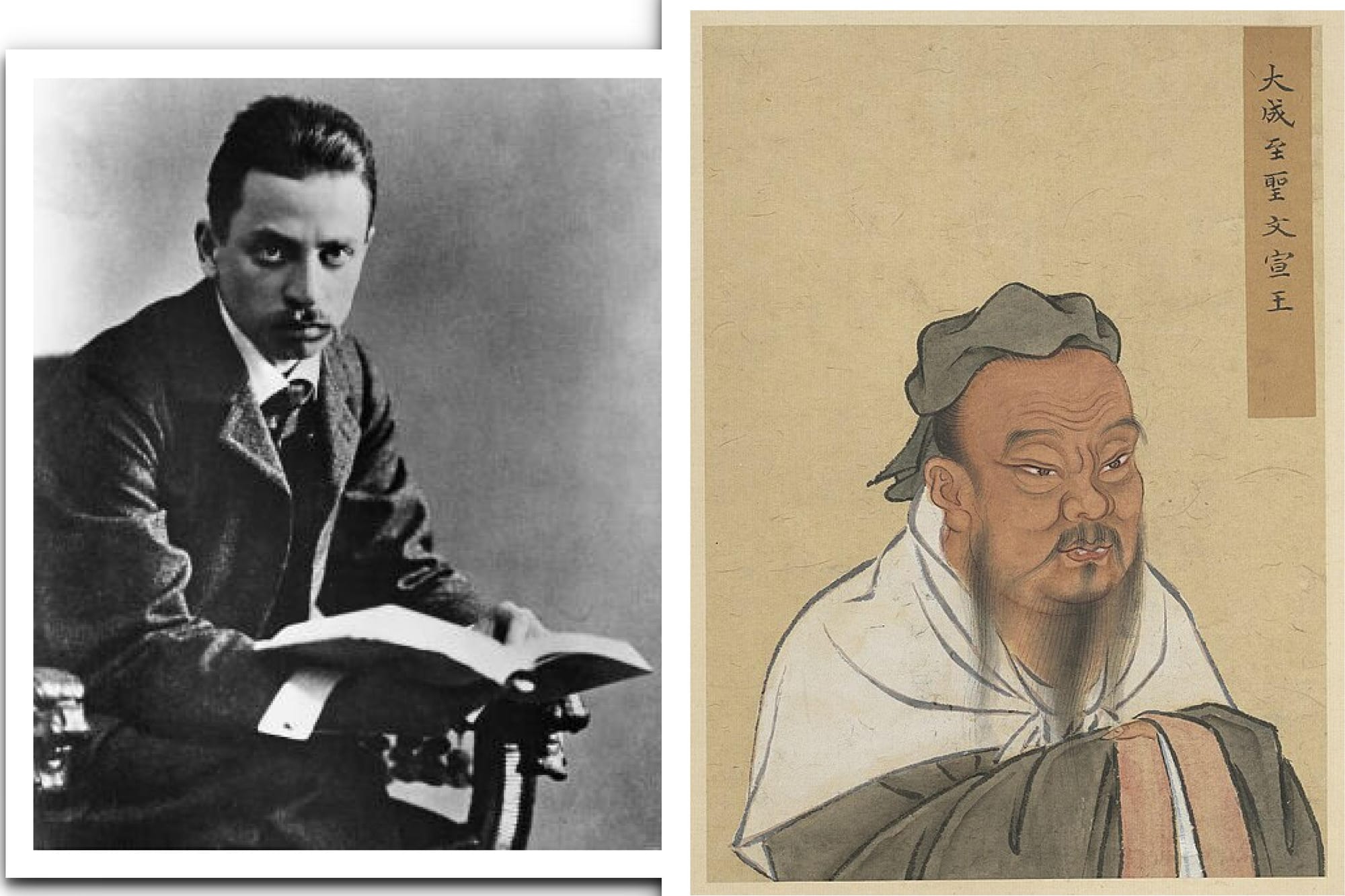
The project finds a further element of coherence in its title, which Amici connects to two seemingly distant literary and philosophical references: a passage from Confucius’s Analects, in which the ceaseless flow of existence is compared to the unending course of a river, and the final line of Rainer Maria Rilke’s Sonnets to Orpheus. This juxtaposition reflects more than a desire to establish a cultural bridge between East and West; it allows us to recognize a shared fundamental intuition: existence manifests itself through the continuous transition from one condition to another, and identity is defined not by permanence, but by the capacity to undergo change. Music is perhaps one of the most compelling expressions of this truth, since it cannot escape time without ceasing to exist.
From a performance perspective, the recording brings together musicians primarily associated with the Chinese musical scene: Yun Tang on violin, Peiyao Guo on cello, Yaxin Dang on flute, Yue Xia on clarinet, Siyue Yang on piano, and Jiran Niu on percussion. The realization of a project consisting of such a fragmented sequence of pieces requires, above all, a firm command of proportions, precision of attack, and the ability to endow highly concentrated musical situations with expressive autonomy. The chamber-music dimension, far removed from any sense of monumentality, appears entirely consistent with the nature of the cycle, in which attention to detail often takes precedence over the breadth of musical development. This is writing that demands attention not only to what is played, but also to the ways in which sound emerges, transforms itself, and gradually disappears.
One critical question, naturally, remains open: to what extent could listeners independently recognize the references to the I Ching without knowing the titles or the compositional procedures? There can be no unequivocal answer. Music does not possess a vocabulary capable of directly translating images such as the mountain, the lake, thunder, or return. Yet this impossibility does not necessarily represent a limitation of the undertaking. On the contrary, it constitutes one of its most fertile possibilities. If the hexagrams were reduced to mere sonic emblems, the project's interest would quickly be exhausted by the verification of correspondences. The Roman composer instead chooses a more stimulating path, one in which the philosophical reference operates within the compositional structure itself, while listeners remain free to experience the music independently of any knowledge of the symbolic system that generated it.
To the Fleeting Water Say thus emerges as a reflection on the possibility of conceiving musical composition through a principle of continuous transformation, without relinquishing formal control or the recognizability of the musical materials. Its appeal lies neither in the exoticism of an Eastern inspiration nor in any claim to translate ancient divinatory knowledge into sound, but rather in the desire to explore the relationships between identity and difference, continuity and discontinuity, energy and stillness. In these thirty-five miniatures, brevity becomes a means of concentration, while musical thought finds in the structure of the hexagrams a model through which to explore the multiplicity of becoming. Ultimately, what remains is not the pronouncement of an oracle, but something more intrinsically musical: the awareness that every sound acquires meaning through change, and that precisely in its inevitable transience a form of knowledge may reveal itself.
Given the compositional context and the importance of absolute timbral clarity, the recording quality plays a fundamental role. Indeed, simply reading the name of Paolo Carrer as sound engineer in the CD inlay, even before listening to the recording, was enough to convince me that the final result would be of outstanding quality. And so it proved. The dynamic performance is exemplary in its transient speed, perfectly controlled energy, and exceptional naturalness, allowing the listener to perceive acoustically the overlapping layers of sound produced by the various instruments. Consequently, in terms of soundstage reproduction, the acoustic space is reconstructed with a remarkable ability to project the three-dimensional presence of performers and instruments into the listening environment, while simultaneously preserving a clear sense of their physical separation. The sound radiates both vertically and horizontally without sacrificing an ounce of precision or definition.
Tonal balance, moreover, provides excellent differentiation between the lower-midrange and upper registers, something particularly noticeable when the instruments overlap without ever losing their distinctive timbral identities, which remain consistently perceptible and essential to appreciating the subtleties of the compositional writing. Finally, there is the level of detail, accompanied by an almost surreal abundance of blackness in the background, which seems literally to envelop each instrument, endowing it with such physical substance and three-dimensional presence that one has the impression the six performers have suddenly materialized in the listening room, thanks to a sense of palpability that is nothing short of visceral. Chapeau!
Andrea Bedetti
Maximiliano Amici – To the Fleeting Water Say. 35 Musical Hexagrams after the I Ching
Yun Tang (violin) – Peiyao Guo (cello) – Yaxin Dang (flute) – Yue Xia (clarinet) – Siyue Yang (piano) – Jiran Niu (percussion)
CD Da Vinci Classics C01225
Artistic rating 4,5/5
Technical rating 5/5