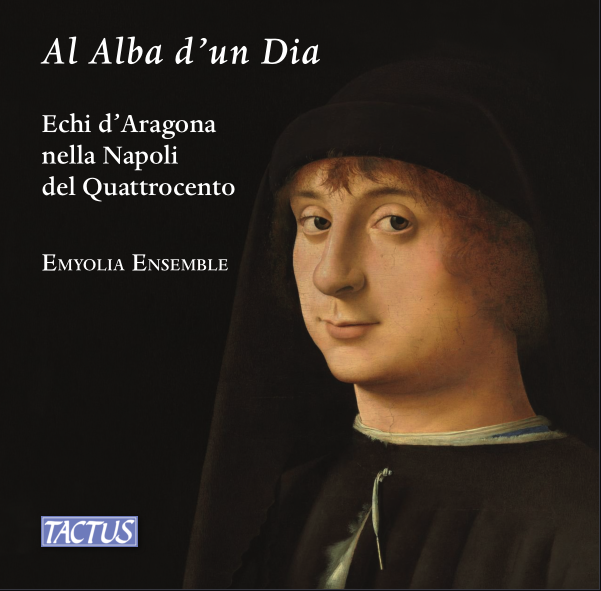
With the conquest of the Kingdom of Naples by Alfonso V of Aragon, completed in 1442, the Neapolitan capital entered a period of extraordinary political and cultural transformation. The Aragonese court became one of the principal centres from which Mediterranean humanism radiated, a place where Iberian, Italian and Franco-Flemish traditions could meet and influence one another. Music played a far from secondary role in this process, serving not only as a refined instrument of dynastic representation but also as a language capable of expressing the aspirations, emotions and attitudes of a society undergoing profound change. It is precisely this musical world that the Emyolia Ensemble has sought to evoke through an interesting and stimulating programme presented on the CD entitled Al Alba d’un Dia. Echi d’Aragona nella Napoli del Quattrocento, released by the Italian record label Tactus.
The significance of this project lies above all in its determination to restore due recognition to a body of secular music that has all too frequently been regarded as marginal in comparison with the great sacred polyphony of the late Middle Ages and the Renaissance. In fact, compositions intended for courtly entertainment, dancing, convivial celebrations and the expression of amorous feelings bear witness to a decisive turning point in the history of European sensibility. Through the gradual emergence of vernacular languages and relatively concise poetic-musical forms, music began to give greater prominence to a more immediate dimension of human experience, without, however, sacrificing compositional sophistication.
It was precisely in Aragonese Naples that this phenomenon acquired particular significance. The presence of musicians from the Iberian Peninsula encouraged the circulation of repertoires in which popular traditions were reworked according to learned conventions, while contact with Franco-Burgundian polyphony helped enrich their expressive possibilities. The villancico, destined to become one of the most representative forms of Spanish musical culture, provides an eloquent example of this intermingling: the recurrence of the refrain, the clarity of the strophic structure and the immediacy of the melodic writing coexist with contrapuntal procedures that reveal its association with a musically sophisticated environment. Rather than a simple opposition between popular and aristocratic music, therefore, this was a continuous process of mutual appropriation and transformation of their respective musical languages.
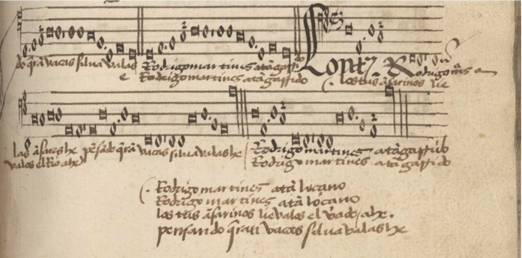
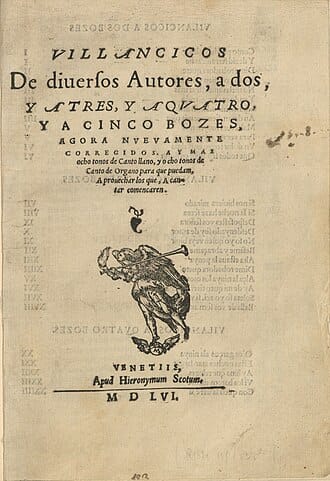
The Emyolia Ensemble's programme reconstructs this musical landscape through sources drawn primarily from the Cancionero Musical de Palacio, the Cancionero de la Colombina, the Bologna Q16 manuscript and the later Cancionero de Upsala, the latter published in Venice in 1556. Although this selection extends beyond the chronological boundaries of the fifteenth century, it enables listeners to trace the continuity and evolution of a musical tradition spanning the Middle Ages and the Renaissance. Naturally, these sources do not exclusively document musical production in Naples: taken together, they instead evoke a plausible cultural horizon for the Aragonese court, shedding light on the network of relationships through which musicians, manuscripts and performance practices circulated across the Mediterranean.
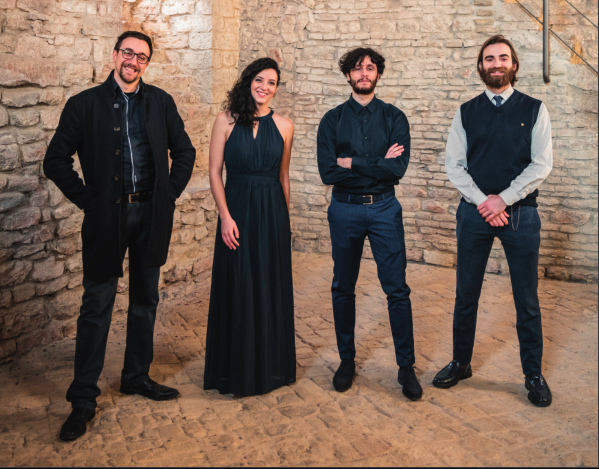
From an interpretative standpoint, the quartet comprising Matteo Magna (hammered dulcimer, percussion and voice), Giulia Testi (lute and voice), Arduino Melelli Roia (lute, vihuela and voice) and Alessandro Zucchetti (lute and voice) favours an approach characterised by communicative freshness, rhythmic flexibility and transparency of timbral combinations. The voices retain a predominantly natural delivery, free from any melodramatic emphasis, while the plucked instruments play a decisive role in shaping the articulation of phrases and sustaining the rhythmic pulse of the dances. The result is an interpretation that seeks above all to recreate the social and convivial dimension of this music, without turning the pieces into archaeological relics constrained by excessive deference to historical scholarship.

Particularly noteworthy is Rodrigo Martínez, in which the insistent refrain and lively instrumental interplay bring out the narrative, almost theatrical character of the composition. The ensemble effectively emphasises its energy through rhythmically incisive accompaniment and vocal delivery that preserves the spontaneity of storytelling. Tres morillas m’enamoran reveals a different character, its light melodic writing and gentle interweaving of voices evoking the intercultural imagery characteristic of Iberian poetic tradition. Here, the balance between voices and instruments is especially successful, ensuring that the accompaniment never compromises the expressive simplicity of the piece.
Equally interesting is the amorous and melancholy side of the repertoire, represented by compositions such as Nunca fue pena mayor, Ay luna que reluces and Al alba venid, buen amigo. These pieces reveal a sensibility in which individual emotion finds expression through recognisable melodic formulas and readily comprehensible poetic structures. The Emyolia Ensemble approaches this repertoire without seeking artificial psychological profundity, relying instead on clarity of diction and natural phrasing. The programme also includes an instrumental piece, Falla con misuras, which recalls the importance of dance practices and variation upon pre-existing melodic models, demonstrating how secular music also provided fertile ground for experimentation. At the more openly festive end of the spectrum, works such as Hoy comamos y bebamos and Dindirindín testify to music's ability to translate the exuberance of communal life into artistically structured forms.
The sacred dimension is also appropriately represented. The inclusion of Verbum caro factum est and the Canto della Sibilla reminds us how permeable the boundaries between sacred and secular music could be, particularly in terms of performance practices and the circulation of melodies. In Verbum caro factum est, the vocal writing is presented with a restraint that allows the distinctive interplay between Latin and the vernacular to emerge, offering significant evidence of a devotional culture in which textual intelligibility was becoming increasingly important.
The principal strength of this recording therefore lies in its ability to present a historically complex repertoire through an interpretative approach that is accessible and musically persuasive. At times, the consistent pursuit of fluency and pleasing timbral qualities tends to soften the distinctions between the strictly courtly dimension and the more popular elements of the repertoire. On the other hand, this very homogeneity contributes to the narrative coherence of the project as a whole. Ultimately, Al Alba d’un Dia possesses a merit that extends beyond its purely musical achievements: it reminds us of that Aragonese Naples was not merely a centre for the reception of major European artistic currents, but a laboratory of cultural mediation in which secular music helped redefine the relationship between poetry, music and society. This heritage anticipated some of the fundamental characteristics of Renaissance musical culture, and the Emyolia Ensemble brings it back to contemporary listeners with intelligence, sensitivity and a convincing sense of expressive vitality.
The sound recording, engineered by Gabriele Berioli, facilitates the perception of the vocal lines and instrumental articulations, enhancing the chamber-like character of the performances. This is achieved through a clean, well-controlled dynamic response, characterised by speed and sufficient energy, free from unwanted colouration. In terms of soundstage, the performers are positioned centrally between the loudspeakers, with a respectable sense of depth, while neither the width nor the height of the soundstage is compromised. Tonal balance and detail retrieval reveal no significant flaws or inaccuracies: the former maintains a clear distinction between the lower-midrange and upper frequencies, while the latter provides a respectable degree of background blackness around the voices and instruments.
Andrea Bedetti
Al Alba d’un Dia. Echi d’Aragona nella Napoli del Quattrocento
Emyolia Ensemble
Tactus CD, TD 490003
Artistic rating 4/5
Technical rating 4/5