The Six Cello Suites for solo cello represent one of those summits of musical literature that seem to offer a natural resistance to any transcription, for the simple reason that a spontaneous conviction arises: artistic perfection should not be touched or altered. And yet, the history of Bach interpretation itself teaches us that precisely those works with the most solid architectural structure are capable of surviving even a change of expressive medium—provided that the instrument stepping in does not claim to replace the original, but merely limits itself, so to speak, to offering a different listening perspective.
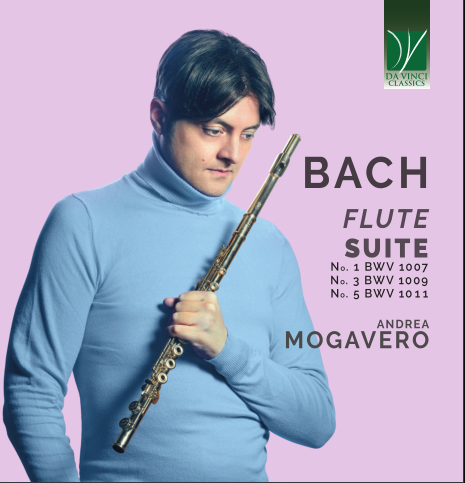
This is the principle underpinning the new project by Apulian flutist Andrea Mogavero, dedicated to Suites BWV 1007, 1009, and 1011 in the transcription for solo flute by Luca Bellini, recorded on a CD recently released by Da Vinci Classics.
Anyone accustomed to the Kantor’s cello masterpiece knows full well that Mogavero’s choice of this specific repertoire is in itself significant: the First, Third, and Fifth Suites outline an expressive journey leading from the luminous immediacy of BWV 1007 to the austere introspection of BWV 1011, passing through the monumental balance of BWV 1009. This makes it clear that the project avoids any purely demonstrative intent, choosing instead to build a coherent itinerary in which the flute is called upon to measure itself against some of the most complex challenges of Bachian writing implicit polyphony, harmonic tension entrusted to a single melodic line, and the balance between dance and meditation.
Luca Bellini’s transcription stands out above all for one virtue: it renounces all cheap virtuosity. Hence, it does not seek spectacular effects or artificial layering but tends to preserve the rhythmic profile and pace of the original text, allowing the phrasing to suggest the harmonic dimension. Undoubtedly, this is a wise choice, as it avoids turning Bach into an exercise in flutistic bravura and keeps the logic of the musical discourse at the centre.
On these foundations, Andrea Mogavero has crafted an interpretation marked by restraint and control. Furthermore, upon listening, one cannot help but notice and appreciate the quality of his tone production—homogeneous across the instrument's entire range—which supports an ever-limpid melodic line, free of mannerisms and guided by phrasing of evident stylistic awareness. The articulation is crisp without becoming analytical, and at the same time, the breathing does not interrupt the flow of the musical discourse, but becomes an integral part of it, helping to shape the great formal arches. Particularly convincing was the way in which the interpreter tackled the central challenge of these transcriptions: namely, suggesting harmonic depth without being able to rely on the resonance of the cello. Mogavero perfectly understood that he had to avoid imitating what the flute cannot be, choosing instead to enhance its own inherent qualities: the purity of timbre, the natural cantabile quality of the line, and the transparency of articulation. The result is a reading that does not replace the original, but rather illuminates different aspects of it, particularly in the clarity with which the implicit contrapuntal design and the balance of formal proportions emerge.
Naturally, the comparison with the cello remains inevitable, especially in the Fifth Suite, where the density of the writing and the almost ascetic character of the Sarabande represent a most rigorous test. Yet it is precisely here that the project demonstrated its legitimacy: not by seeking impossible equivalences, but by offering a different idea of musical eloquence, entrusted not to the physical sound material of the string, but to breath as the constructive principle of phrasing. Moreover, even from a stylistic standpoint, the interpretation convinced through its balance; the dynamics were restrained, never theatrical, the agogic nuances avoided arbitrary liberties, and the melodic line always retained that composure belonging to the best Bachian tradition. In short, it was an approach that favoured the continuity of musical thought over immediate effect, successfully avoiding any romantic temptation.
There is, furthermore, another aspect that must be clarified in light of the Apulian flutist's interpretation: this album does not intend to demonstrate that the Cello Suites are "also" works for flute. Rather, it invites the listener to verify how much Bach’s writing transcends the timbre of the instrument for which it was born. On these premises, if the transcription succeeds, it is because it highlights the extraordinary self-sufficiency of the Kantor's musical thought, capable of retaining its identity and expressive power even when the voice uttering it changes. It goes without saying that to fully appreciate the scope of the interpretation and sensitivity demonstrated by Andrea Mogavero, it is at least necessary to know the original version of these Suites, because one cannot appreciate new perspectives without knowing the landscape being admired.

The sound recording, engineered by Carlo De Nuzzo and Irene Marchese, is also well crafted. The dynamics are marked by fast transients and an energy capable of highlighting even the nuances offered by the instrument during micro-dynamic passages, while preserving timbral naturalness from any improper coloristic artifice. In terms of the soundstage, the flute is carved out at the centre of the acoustic space at a discreet depth, without the sound being penalized in height or width. The tonal balance shows no flaws whatsoever, with a focus of registers that do not overlap or clutter, even in passages where the transition between lower-mid and high registers is nearly instantaneous. Finally, the detail yields a tactile sense of texture, with a generous amount of black background that focuses the flute, allowing for a listening experience that is never fatiguing.
Andrea Bedetti
Johann Sebastian Bach – Flute Suite No. 1 BWV 1007, No. 3 BWV 1009, No. 5 BWV 1011
Andrea Mogavero (flute)
CD Da Vinci Classics C01185
Artistic rating 4,5/5
Technical rating 4/5