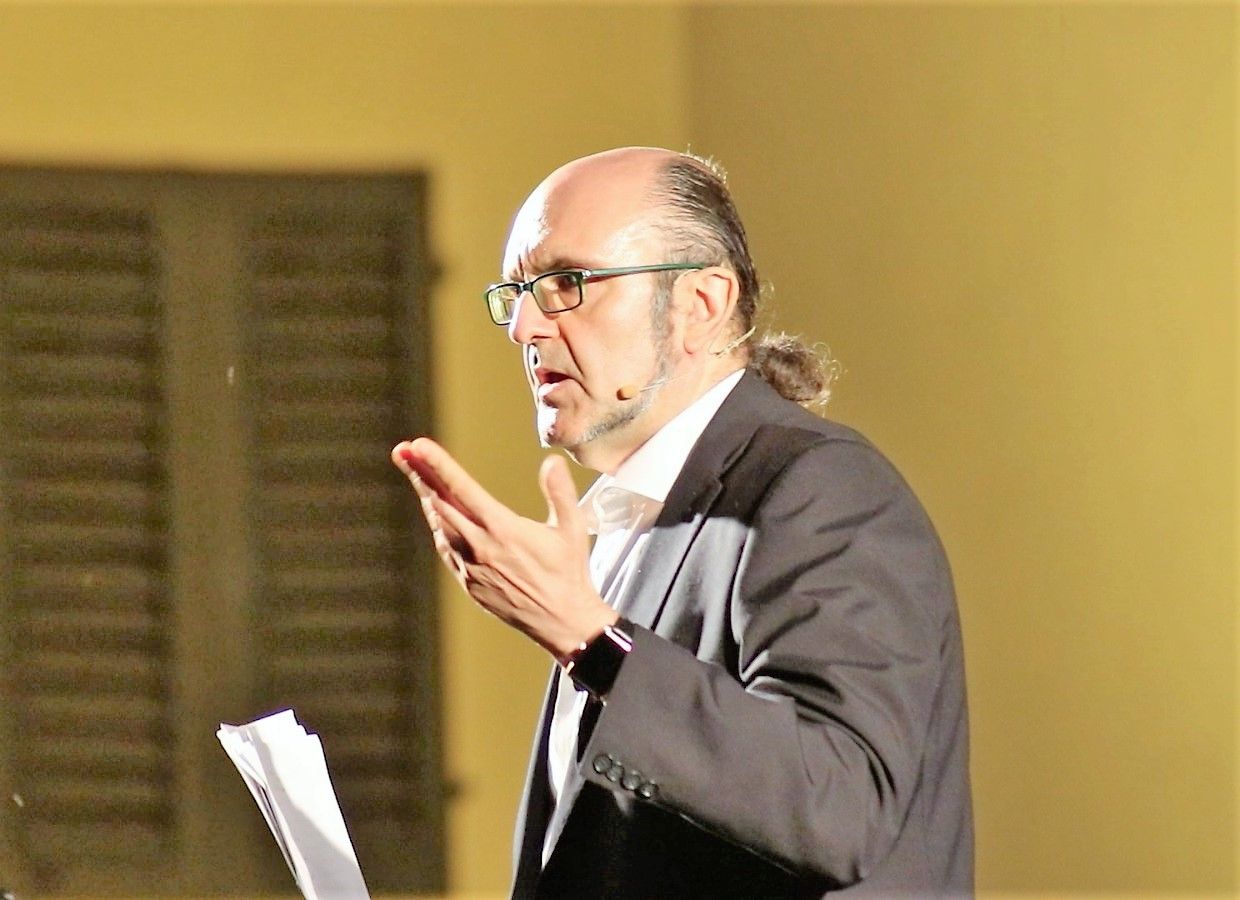
Every recording project concerning the Milanese composer Carlo Alessandro Landini involves not only the purely sonic aspect—that is, the acoustic transmission of an artistic creation—but inevitably also implies a speculative dimension. This is because the musician in question belongs to that rarest cohort of composers whose musical output demands not only attentive and engaged listening, but also an ongoing reflection that unfolds at the very moment the sound propagates and takes possession of the surrounding space. In the same way, one listens to Landini’s music to think, ensuring that sound is purely time rather than a sterile and vacuous pastime. This is why—and in stating this, I have no desire to stir up controversy or any kind of fuss—his renown is unfortunately recognized for the most part only abroad, where his name and work are justly celebrated, whereas in our dear (so to speak) provincial nation, they are frequently met with condescension, if not a whiff of annoyance and arrogance. I am sorry to write this, but that is the reality.
The reasons for the perpetuation of the saying nemo propheta in patria regarding Landini can be briefly summarized in a few points: a total lack of political subservience; a disarming personal candor, often mistakenly conflated with arrogance and a detachment smacking of a (false) misanthropy; the fact of being a well-rounded humanist in an era where hyper-specialization dictates that we view with suspicion anyone who tends to excel in other fields (the Milanese composer is also, on equal footing with his musical stature, a philosopher of the highest pedigree, as evidenced by the various books in which he has poured his brilliant and acute reflections); and, what concerns us more closely, the fact that, through his aesthetic vision applied to the world of organized sounds, he has resolutely turned his back on the mainstream of today's musical establishment—one dominated more by ideology than by art—and, even more seriously, for having snubbed the trickles of an experimentation that is an end in itself. The seeds of this experimentation can be traced back to the power of the "left hand" or the "dark side" continuously spoken of in the Star Wars film saga, inherited by the children, grandchildren, and great-grandchildren of the Darmstadt Summer Courses, whose existence and activity have yielded juicy fruits just as much as miasmic poisons that still pollute the creative air we breathe today.
In short, without wishing to invoke illustrious names and make comparisons that might appear, if not embarrassing, then at least vulnerable to exploitation by those always ready to plunge body and soul into vis polemica, what is happening in our petty little Italy regarding our composer reminds me of how, back in the 1960s (I reiterate, the 1960s of the last century), Gustav Mahler's name and compositions were still viewed with suspicion and admired only within what could at best be described as esoteric circles of local critics and listeners. But there it is...
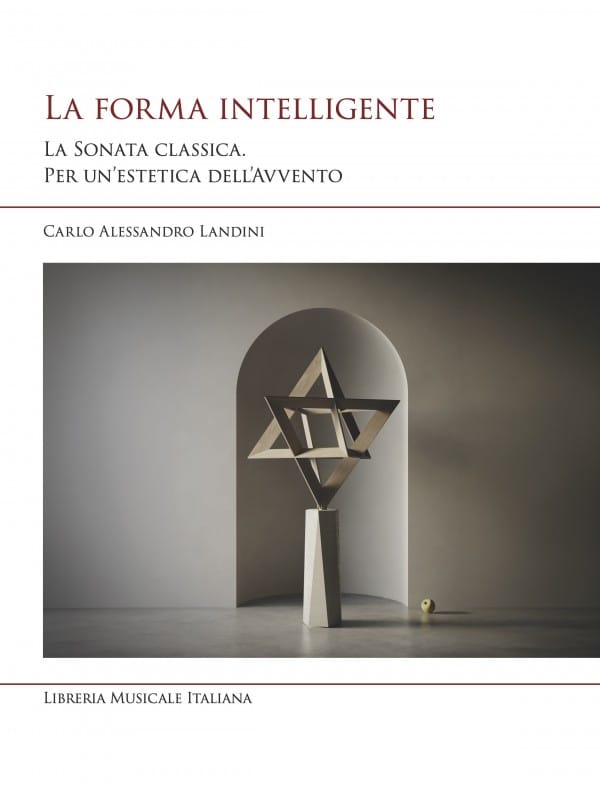
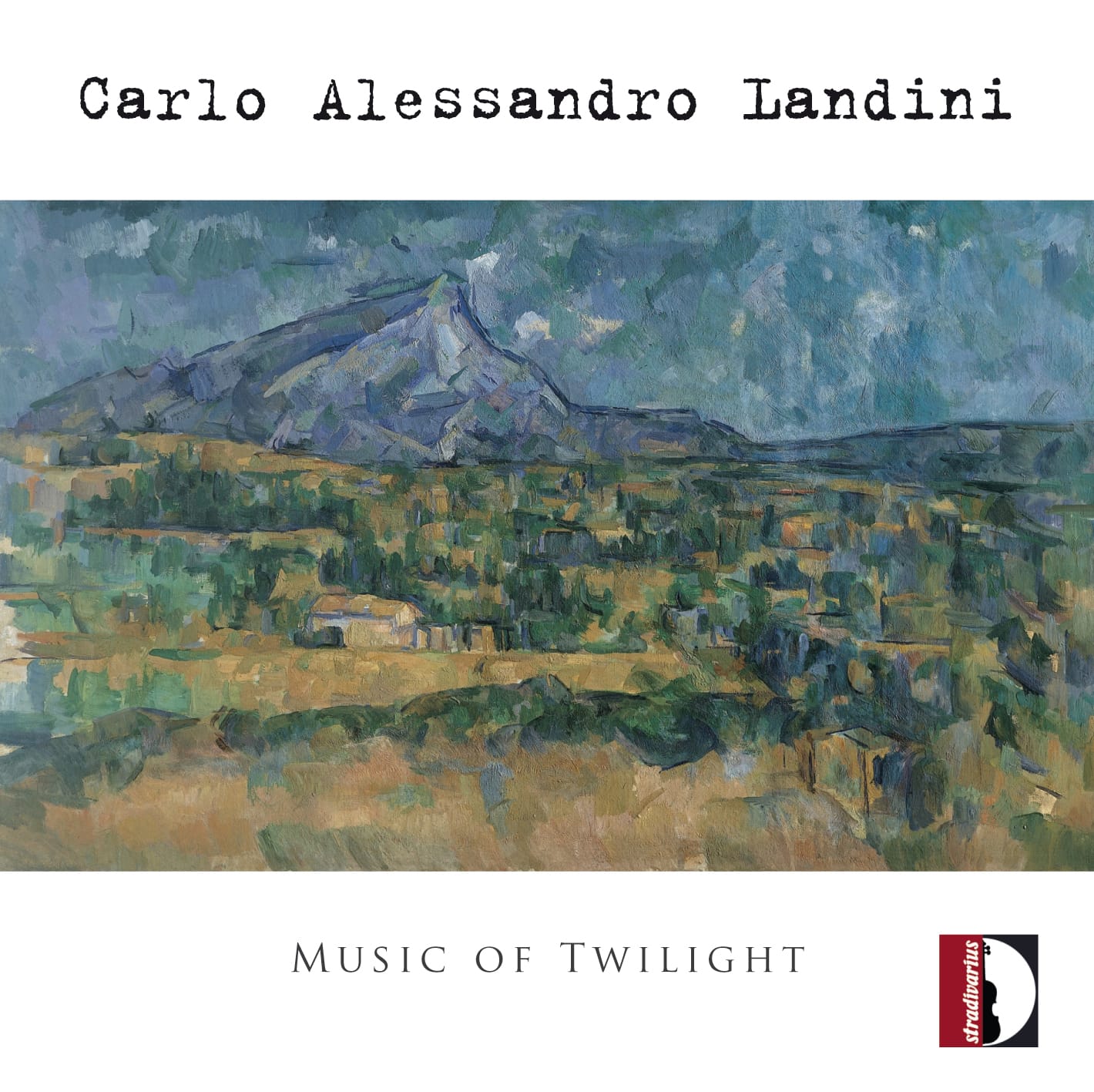
Having clarified this, out of love and necessity for intellectual honesty, I come to the core of my critical commentary which concerns, precisely, a new album by Carlo Alessandro Landini recently released by Stradivarius and titled Music of Twilight. It features four tracks scored for different ensembles: View of the Cathedral of Wroclaw from the Odra River (composed in 2016) for orchestra; Epiphanè (1995–96) for five instruments; So führ’ mich, Herr, in Himmel ein (2021–22) for nine instruments; and This Heart Thy Center Is, This Flesh Thy Sphere (from a poem by John Donne) (2010) for piano, clarinet, and violin—compositions, therefore, spanning a period of just under three decades. Since this is not the first time I have critically and speculatively addressed the musical works of the Milanese composer, there is no need for me to dwell on his stylistic characteristics and peculiarities. Rather, these four pieces can offer another type of corroborated and further focused insight if we consider that, concurrently with the release of the Stradivarius CD, the LIM publishing house in Lucca has published an essay by Landini entitled La forma intelligente. La sonata classica - Per un’estetica dell’Avvento (Intelligent Form: The Classical Sonata – Towards an Aesthetics of Advent). In this work, musicological analysis is enhanced and refined by philosophical speculation, as well as by reflections on the world of art, architecture, and spirituality. Indeed, it is the very concept of form—which is understandably close to our author's heart—that has driven him to dedicate a volume of over four hundred and fifty pages, pouring into it insights, references, analogies, controversies, and thoughts. Through these, he enables the courageous and sufficiently prepared reader to understand just how important, fundamental, and unavoidable the question of form still remains, especially in the face of an era whose "liquidity"—to borrow the words of the Polish philosopher and sociologist Zygmunt Bauman—has by now mutated into an open and pernicious "gaseousness."
Now, this is not the place—both due to its complexity and for reasons related to other editorial requirements into which I will channel my reflections and analysis dedicated to the aforementioned essay—to tackle Landini's latest book; yet, its intellectual and artistic condensation can offer insights that connect ideally with the compositions making up Music of Twilight. This is because what the Milanese composer speculatively explains and articulates in a manner that is, to say the very least, ruthlessly lucid in his substantial volume is exemplarily demonstrated through his music, as is precisely the case with the four pieces in question.
Form, then—which a certain grossly mistaken prevailing consensus considers akin to a container, a something that delimits, allowing form itself to take shape in order to bring order to the unformed. And this applies not only within the realm of production linked to the world of organized sounds—insofar as the distorted and pernicious contribution made by Romantic-style musical aesthetics has also led to the belief that form serves to contain content, namely a message, an allegory, a "program" through which music itself can have meaning—but it in fact also extends to other expressions of the artistic universe, misled, deceived, and defaced by the conviction that form serves principally or solely such a purpose.

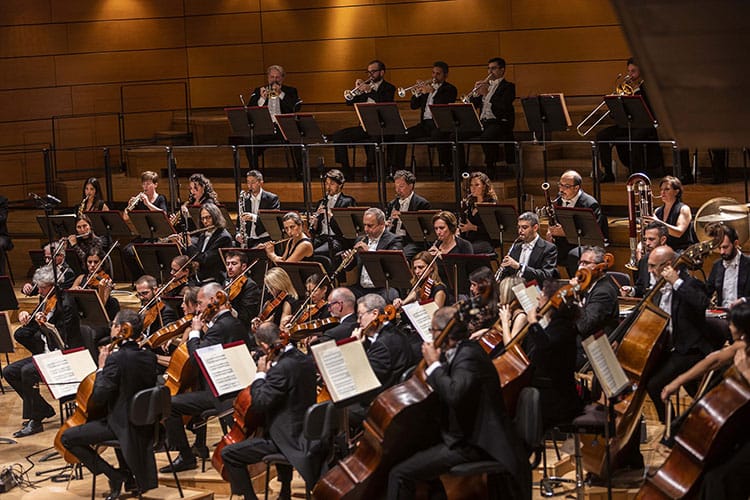
To bring to light the sense of form and its indispensable presence (even in an era that, in terms of musical aesthetics, seems to no longer require it), listening to the first track of the CD is propedeutic. This track features the orchestral work View of the Cathedral of Wroclaw from the Odra River, a piece that draws inspiration from a 1752 woodcut taken from the imposing topographical work composed by the vedutista Friedrich Bernhard Werner. His renown was such that in 1744 he was appointed Königlich Preussischer Scenographicus by Frederick the Great, for the work titled Silesia in Compendio seu Topographia das ist Praesentatio und Beschreibung des Herzogthums Schlesiens. This woodcut, found in the fourth volume of the collection, depicts the Gothic Cathedral of St. John the Baptist in Wroclaw from the perspective offered by the Oder River, which flows through the Polish city. The purpose of this orchestral composition—performed in this recording by the "I Pomeriggi Musicali di Milano" Orchestra under the direction of Yusuke Kumehara—is to give life to a musical form starting from the projection of another form: the architectural one, captured by Werner through his perspective concept, thereby transfiguring the interplay of lines from the structure's Gothic layout into the liquidity of the sonic contribution. Form as a perspectival transposition, but not solely; every process of transition from one entity to another necessarily involves an adding or a removing, activating that existential filter inherent to the creative act. Here, the sound created by Landini is a continuous invitation, a necessary stimulus for the listener to "elevate" their hearing, raising it as if architecturally following the Gothic lines that soar vertically—a visual/auditory ascension that is also an invocation of a spirituality perpetually proclaimed in its musical progression. And the Milanese composer achieves this through a systematic use of string glissandi (the piece's opening ideally echoes the one offered by Benjamin Britten in his opera A Midsummer Night’s Dream, which had the precise intent of transporting the listener "towards other worlds"), while the orchestral mass in its "descriptive" unfolding acoustically reveals the volumetry of full and empty spaces, rendered by timbral explosions and implosions that alternate within the structural dynamism of the cathedral, saturated with mysteries (we understand each other, don't we, Fulcanelli?).
The following piece, Epiphanè, for piano, clarinet, flute, trumpet, and French horn—featuring the musicians of the Giacinto Scelsi Ensemble conducted by Gloria Clemente—has a strong "theatrical" flavour, in the sense that we find ourselves before five characters, embodied by their respective instruments, who in a Pirandellian fashion have lost their author/god, thereby giving life to a concentric and labyrinthine "Tower of Babel," insofar as each expresses a construct that is linguistically misunderstood by the others. Five lines/forms that alternate, overlap, clash, and tell each other to go to hell, to the point where misunderstanding and non-communication—again on a theatrical level—inevitably give way to Beckettian overtones. I am well aware that Landini cordially detests Fellini's cinema, but there is no doubt that in the progression each instrument/character displays to test the waters before initiating an expressive discourse that will never achieve a "completed form," there is a distinct echo of Orchestra Rehearsal by the director from Rimini. In that film, the dissonant unfolding generated by every orchestral instrument progressively becomes the precursor to an atomizing anarchy—the very same that Landini exposes in this piece, albeit in a way that is obviously less "uproarious," less coarse, but no less effective and propedeutic. It is as if to say that the divergence of form can be a vehicle for dissociation and alienation, a continuous and fruitless "resetting" (pardon the crude jargon) without this process ever actually leading to any successful communication.
The third piece, So führ’ mich, Herr, in Himmel ein—based on a 17th-century Pietist text on the transience of life—highlights, in my view, other aspects that must be underscored, quite apart from the "religious" connotations infused by Heinz Zietsch's accompanying CD liner notes. To begin with, there is the semantic aspect provided by one of the most fascinating (and, for obvious reasons, hated) verbs in the German language, namely zu führen, which translates as "to guide," "to lead," and also "to actively direct." Through Landini's sonic universe, this sheds light on the capacity of form to shape itself in continuous movement. This leading of man towards another dimension is formed by the Milanese composer through a constant, relentless use of dissonant chordal cores. At first, these appear to be systematized in such a way as to express confusion, anguish, and bewilderment, only to progressively advance (and herein lies Landini's unquestionable ability to mold sonic matter) towards a logicality of musical form that invites the listener to contemplate a piecemeal transition from horizontality to verticality—another theme dear to our musician. This occurs through a timbral deployment of the nine instruments, wherein their addition or subtraction necessarily alters the shift from a dissonant dimension to one that is close to (though not definitively) consonantic. The radiance of the consonantic unfolds in the very final bars of the composition, thanks to the stable, almost reassuring line of the clarinet, which suggests the half-closing of something that lies beyond. A fascinating, seductive piece that demands further listening to be properly metabolized in its creative essence (thanks also to the remarkable reading by the Gruppo Bruno Maderna conducted by Remo Pieri).

The last piece, This Heart Thy Center Is, This Flesh Thy Sphere—drawn, as mentioned, from the final line of the poem The Sun Rising by the English Metaphysical poet John Donne—actually features two words that Landini changed from the original version: namely, Heart takes the place of Bed, and Flesh replaces Walls. This is a alteration that speaks volumes about the composer's intentions, as if wishing to inject an impulse of "transubstantiation" into the semantic caliber of the composition—a desire to transform the physical into the metaphysical, going even beyond the spiritual intent of the London-born poet. It is a spirituality that Landini himself has further heightened by adding the violin to the clarinet and piano scored in the original version, thereby "elevating" the score into acute and altissimo registers, and thus allowing the unfolding structure a sort of "levitation," a golden timbral suspension, in the name of a forming that can sometimes also lead to a re-forming. The pianistic and clarinettistic stasis is thus cloaked by a vision—the violinistic one—which is free to expand, to soar, to sway, and to wedge itself between the austere and discreet chords of the other two instruments, just as the heart does in relation to the flesh. The piece is impeccably performed in this recording by Galina Evgenyeva Rossimova on piano, Igor Lukyan Salavëv on clarinet, and Refael Negri on violin.
As always, Andrea Dandolo has delivered a truly remarkable sound engineering, featuring a clean, precise, and fast dynamic range, bolstered by an energy capable of enhancing the timbral contrasts of the instruments. The soundstage parameter reconstructs the instruments and performers squarely between the loudspeakers, positioned at a discreet depth and with a sound that radiates pleasantly in both height and width. The tonal balance and detail do not disappoint either: while the former is duly delineated between the mid-bass and treble registers, the latter is sufficiently tactile, capable of offering a three-dimensional projection of the instruments.
Andrea Bedetti
Carlo Alessandro Landini – Music of Twilight
Various Artists
CD Stradivarius STR 37335
Artistic rating 4,5/5
Technical rating 4,5/5