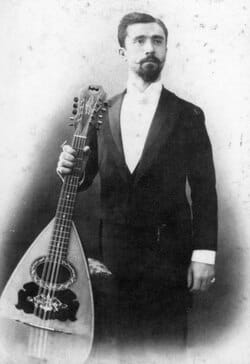
If there are figures in the history of musical instruments in whom the roles of composer, performer and instrument maker ultimately converge, Raffaele Calace (Naples, 1863–1934) represents an almost paradigmatic example. A luthier from a family with a long tradition of crafting plucked-string instruments, as well as a virtuoso, teacher, publisher and composer, Calace played a decisive role in emancipating the mandolin from the predominantly popular and salon-music contexts to which it had long been confined, establishing it as a concert instrument with a repertoire of its own. This process of emancipation, however, should not be considered solely in terms of repertoire in the broader sense, since the Mandolino Classico da Concerto he designed, with a fingerboard extending to the twenty-ninth fret, was specifically conceived to expand the instrument’s technical, timbral and expressive possibilities. At the same time, from a technical and theoretical standpoint, his monumental **Method for Mandolin** (Metodo per mandolino), comprising no fewer than six volumes and published in 1910, systematically explored and codified the instrument’s resources.
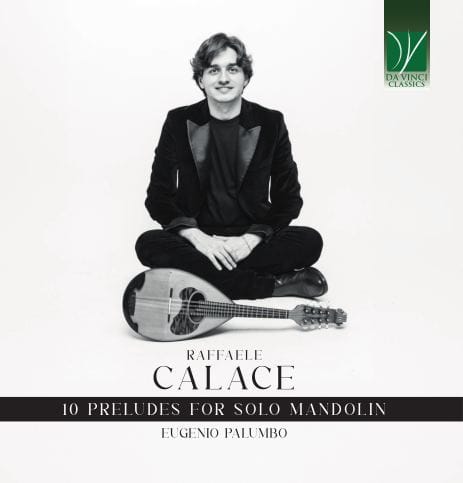
From this perspective, the ten Preludes for Solo Mandolin, brought together in this Da Vinci Classics recording by the young mandolinist Eugenio Palumbo, acquire a significance that goes well beyond that of a mere collection of virtuoso pieces. Composed over almost the entire span of Calace’s career, from Op. 45 to Op. 175, these works do not constitute a cycle conceived as a unified whole. Rather, they belong to a corpus of eighteen Preludes, eight of which were written for the liuto cantabile, and document the progressive development of a compositional language in which the mandolin achieves a remarkable degree of “musical self-sufficiency”. The reference to Paganini’s Caprices, aptly recalled in the album notes written by Palumbo himself, should therefore be understood not so much in terms of imitation as of a shared aspiration to transform instrumental challenges into genuine compositional substance.
It is precisely this aspect that emerges with particular clarity in the interpretation of the young mandolinist from Carpi. Already in Prelude No. I in G major, Op. 45, Calace’s first composition for unaccompanied mandolin, Palumbo avoids presenting the piece as a mere “catalogue of effects”. His plectrum attack is crisp without sounding dry, the tremolo displays continuity and, above all, remarkable dynamic flexibility, while the transitions between rapid figurations, chords and lyrical lines unfold without disrupting the direction of the musical discourse. The result is a sense of multiple layers of sound, one of the most fascinating and distinctive features of Raffaele Calace’s writing.
Even more revealing is Prelude No. III in B minor, Op. 63, in which the virtuosic element coexists with a decidedly more restless and dramatic character. Here, Palumbo demonstrates not only technical assurance – evident in the precision of his attacks and the clarity of even the most demanding passages – but also an ability to differentiate the expressive weight of individual phrases and allow the lyrical element room to breathe. The tremolo is not employed merely as a device for artificially sustaining the sound, but becomes an integral quality of the phrasing itself, capable of generating tension and release.
The very brief Prelude No. XI in G major, Op. 136, composed, like the subsequent Op. 137, during a crossing of the Gulf of Siam aboard the ship Fiume-F, reveals a more agile and sparkling side of the Neapolitan composer and teacher’s musical language. Particularly striking here are the lightness of articulation and the speed with which Palumbo shifts character and timbral perspective, without ever allowing brilliance to degenerate into mere display. By contrast, in Prelude No. XV in G minor, Op. 151, the atmosphere changes once again: the writing becomes more concentrated, at times almost questioning, and our performer effectively conveys its darker nuances, exploiting the interplay between resonance, attack and silence.
The Grand Prelude in D minor, Op. 175, significantly placed at the conclusion of the programme, ultimately allows us to appreciate the distance separating Calace’s mature achievement from his earliest experiments in solo writing. His formal ambitions expand, the musical gestures acquire greater breadth, and the writing seems continually intent on transcending the instrument’s physical limitations. Palumbo approaches the piece without weighing it down: he preserves clarity even in the densest figurations, skilfully controls the mounting tension and, above all, ensures that the overall architecture remains perceptible beneath the spectacular surface.
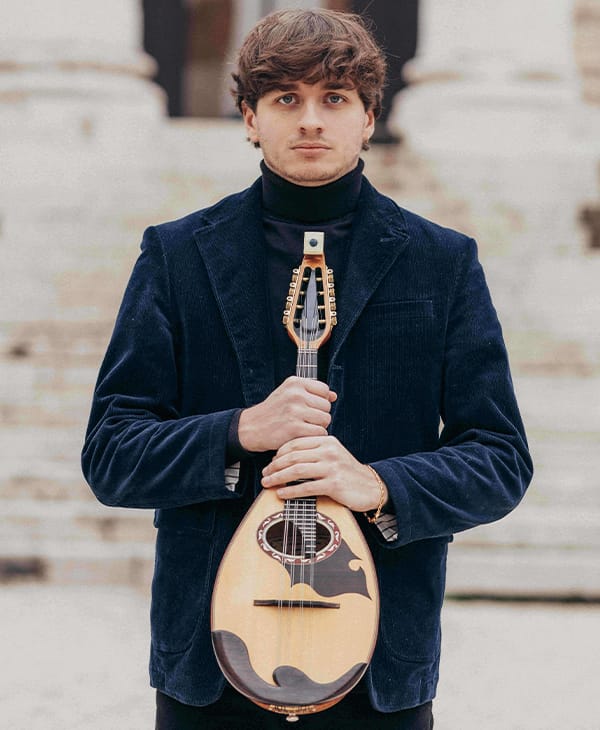
Born in 2001 and initially trained by his father Roberto, before studying with Dorina Frati at the Brescia Conservatory and Vincent Beer-Demander at the Conservatoire Royal de Liège, Palumbo belongs to a generation of mandolinists for whom the rediscovery of the historical repertoire goes hand in hand with an engagement with contemporary music. Indeed, this recording grew out of research into original sources conducted in the Calace family archives and is presented as the first complete recording of the Preludes by a performer belonging to the Italian school of mandolin playing.
The recording engineering, by Andrea Pace and Valdimiro Buzi, also contributes to the project’s overall success. The mandolin is captured with presence and definition, but without excessive emphasis on the plectrum attack, thanks to a highly effective dynamic range and a convincing degree of naturalness. The resonance of the instrument’s body and the natural decay of the sound also remain perceptible, both essential elements in appreciating the interplay between lyrical expression and articulation. The soundstage likewise allows the listener to appreciate the reconstruction of the physical space in which the performance takes place, with the instrument correctly positioned at the centre between the loudspeakers and the sound displaying a convincing sense of both width and height. Equally commendable are the tonal balance and detail: the former respects the instrument’s different registers, while the latter retains an appropriate sense of physical substance.
Andrea Bedetti
Raffaele Calace – 10 Preludes for Solo Mandolin
Eugenio Palumbo (mandolin)
Da Vinci Classics CD C01204
Artistic rating 4,5/5
Technical rating 4/5