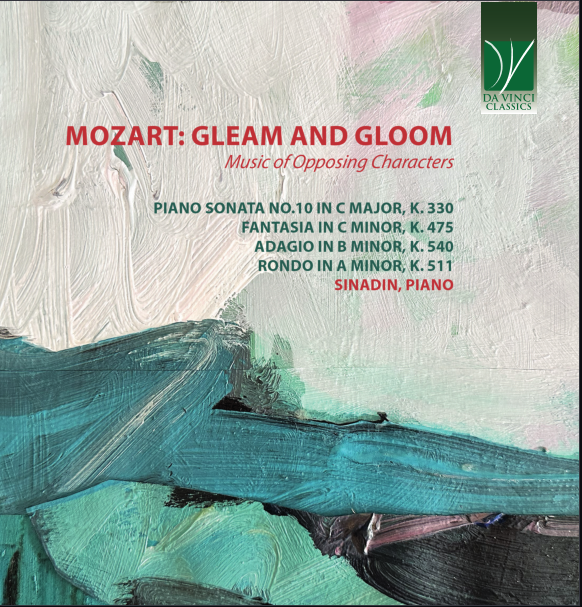
For those who are not particularly familiar with English, the expression “gleam and gloom” might sound like some kind of wordplay or even a tongue-twister. In fact, its meaning is far deeper and more complex, since it may be rendered as “radiance and darkness”, two terms which, in their accumulation and opposition, can ideally be seen as symbolising Wolfgang Amadeus Mozart’s entire sound world. It was therefore a particularly apt choice on the part of the Serbian pianist and music professor Sinadin, the pseudonym of Dejan Sinadinović, to give his Da Vinci Classics release the title Gleam and Gloom. Music of Opposing Characters. This should not be regarded merely as an attractive editorial device, but rather as a way of identifying one of the most profound tensions within Mozart’s piano writing: the coexistence, within music of prodigious clarity, of grace and unease, balance and vertigo, lightness and foreboding.
It is therefore in the name of these “opposing extremes” that Sinadin has brought together the Sonata in C major, K. 330, the Fantasia in C minor, K. 475, the Adagio in B minor, K. 540 and the Rondo in A minor, K. 511: four works — indeed, four masterpieces — which, when placed side by side, trace an expressive geography far more rugged and unpredictable than the conventional image of Mozart often leads us to suppose. This, then, is the perspective adopted by Sinadin, who also handled the recording and sound editing of the album, made in Belgrade at the end of 2025 on a Yamaha CFX concert grand.
Having now reached the end of my listening, I can say that the most interesting aspect of his interpretation lies in the fact that this contrast — the common denominator of the entire recording project — is never pursued through conspicuous effects. In the Sonata K. 330, and especially in the opening movement, Sinadin avoids both precious miniaturism and any display of virtuosity for its own sake. Instead, he opts for a carefully controlled tempo, crisp articulation and a flexible dynamic range that never becomes restless. His phrasing, moreover, favours continuity of discourse, while still allowing those slight asymmetries, shifts of accent and harmonic inflections to emerge clearly — precisely those details that prevent the work from being reduced to a merely radiant eighteenth-century surface. Brilliance, in short, is never flaunted; rather, it is treated as a structural quality.
Even more revealing, as we continue our examination of the Sonata, is the Andante cantabile. Here the Serbian pianist adopts a more inward conception of sound, almost chamber-like in character. The melodic line is neither inflated nor sentimentalised, and precisely for that reason the excursions into F minor acquire particular weight. In this respect, Sinadin does not force the “shadow”, nor does he turn it into an overtly pathetic episode; instead, he allows it to emerge from within the phrase itself, through a different pressure of touch, thereby bringing out a greater harmonic density and a slightly more spacious agogic flexibility. This is a distinctly Mozartian way of understanding sorrow: one that never disrupts the form but rather runs through it like an underground vein. The transition from the Sonata’s outward luminosity to its inner fissures is, moreover, one of the expressive focal points also identified in the accompanying notes, written by the Serbian artist himself.
The Fantasia in C minor, K. 475 naturally constitutes the dramatic centre of the disc. Its episodic form, built on abrupt turns, sudden halts, renewed impulses, and constant changes of register and character, always runs the risk of breaking up into a sequence of distinct, disconnected scenes. Sinadin, by contrast, opts for a more coherent approach, emphasising the narrative unity of the work. The opening projects gravity without heaviness; the pauses become genuine psychological caesuras rather than mere metrical silences, while the more turbulent sections retain a remarkable clarity of texture. When the writing thins out and seems to open onto a suspended improvisatory space, Sinadin never loses his sense of direction, and the compositional “freedom” remains firmly contained within a clearly shaped design. It is perhaps here that his interpretation proves most convincing: not in making Mozart sound “Romantic”, but in showing how his modernity can arise from the inner tension of Classical form itself.
The reading of the Adagio in B minor, K. 540 shifts the centre of gravity even further towards an inward sedimentation of sound. Sinadin adopts a broad tempo, though never a static one, allowing the phrases to breathe with a naturalness that avoids both funereal eloquence and abstraction. The sound retains body even in the softest dynamics, while the use of resonance is carefully calibrated so as to sustain the harmonies without blurring them. The result is a performance of intense concentration, in which each modulation seems to alter the emotional temperature of the discourse. What I particularly appreciated is that the melancholy is not stated from the outset in an overtly “programmatic” way; rather, it forms gradually, almost by sedimentation, as it were. In this sense, the Adagio emerges as the true point of suspension within the programme, the place where the contrast between “gleam” and “gloom” ceases to function as opposition and is magically transformed into ambiguity. After all, the contemplative dimension of the work is central to its very programmatic conception.

The Rondo in A minor, K. 511, for its part, carries this ambiguity into yet another expressive sphere. Sinadin captures very effectively its character as a restrained dance, that elegant gait which seems constantly veiled by some further, unspoken thought. The recurring theme is never quite identical to itself: its weight, perspective and intensity continually change, while the episodes are integrated into an unbroken arc without losing their individual character. Particularly effective is Sinadin’s ability to preserve rhythmic momentum even in the most introspective passages. It should not be forgotten, in this respect, that one of the risks in this Rondo is to allow melancholy to lapse into languor; Sinadin avoids this through a constant control of the pulse and through phrasing that remains lucid even when the harmonic language grows more unsettled. It is precisely this coexistence of structural rigour and expressive intensity that makes K. 511 one of the high points of the programme.
I must admit that, before listening to the disc, when I read that the Serbian pianist had chosen a Yamaha CFX, I was somewhat surprised, given the particular characteristics of the instrument in relation to those of the Mozart works selected here. That initial reservation disappeared, however, once I realised that the piano had been used above all for the clarity of its attacks and for the precision with which the different planes of sound can be graded. In other words, there is no attempt to evoke a “historical” patina, nor any artificial effort to imitate the fortepiano. On the contrary, Sinadin consciously embraces the timbral and dynamic potential of the modern concert grand, while at the same time disciplining its power through a strict control of weight and resonance.
Overall, this Da Vinci Classics recording project avoids two common pitfalls in Mozart interpretation: on the one hand, the cult of an Apollonian perfection that ultimately sterilises the musical discourse; on the other, the temptation to burden every darker area with proto-Romantic meanings that simply do not belong there. Sinadin, instead, follows a subtler path. His reading is thoughtful, analytical, at times even austere, yet never cold; above all, it is underpinned by a coherent conception of Mozart as a composer of opposites, capable of allowing a smile and a fracture, playfulness and foreboding, to coexist within the same phrase.
It is precisely when these polarities cease to appear as opposites and reveal themselves instead as different facets of a single musical consciousness that the disc finds and expresses its deepest raison d’être. The result is a Mozart far removed both from eighteenth-century porcelain elegance and from any anticipation of Romanticism: a more enigmatic composer, in whom formal perfection does not attenuate unease, but rather provides it with the exact space in which to emerge. It is this tension, sustained without affectation, that makes the listening experience not merely elegant, but intellectually and expressively challenging in the best sense of the term. By way of conclusion, anyone wishing for a further indication of how this “gleam and gloom” problematic can be visualised should look closely at the CD cover, which reproduces a painting by the Serbian pianist and professor himself, following the rhythm of the brushstrokes and the interplay of colours that emerge from them.
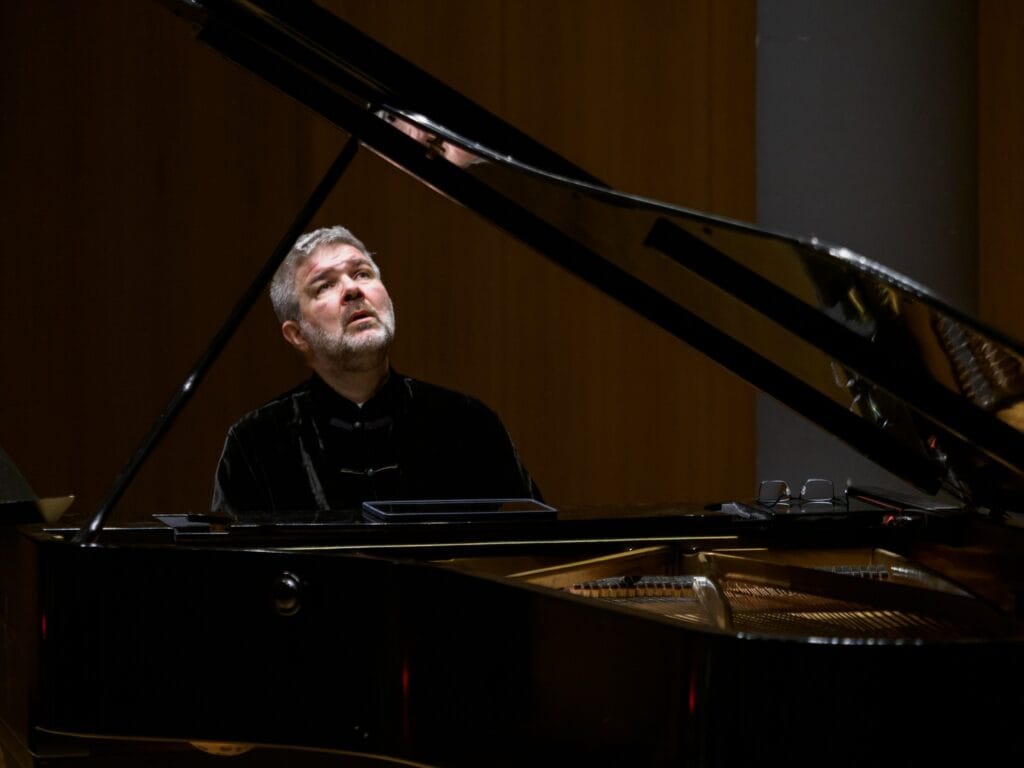
Sinadin, besides proving himself a sensitive and perceptive artist in tackling works of such difficulty and so full of interpretative pitfalls, is equally accomplished in the technical aspect of the sound recording, which was made in an unspecified private venue. The dynamic range is very good, providing clarity, naturalness and energy without introducing artificial or contrived colouration, and in this respect also highlighting the quality of the piano’s sound. The soundstage places the instrument centrally between the loudspeakers, with a fair degree of depth that does not compromise the projection of the sound in either height or width. The tonal balance, too, is free from obvious flaws and, thanks to a clear distinction between the treble and the middle-low registers, allows the listener to perceive very effectively the physical and sonic contrast between light and shadow. Detail retrieval is more than sufficiently tangible to convey the three-dimensional presence of the piano and a convincing sense of its tactile substance.
Andrea Bedetti
Wolfgang Amadeus Mozart – Gleam and Gloom. Music of Opposing Characters
Sinadin (piano)
Da Vinci Classics CD C01202
Artistic rating 4,5/5
Technical rating 4,5/5