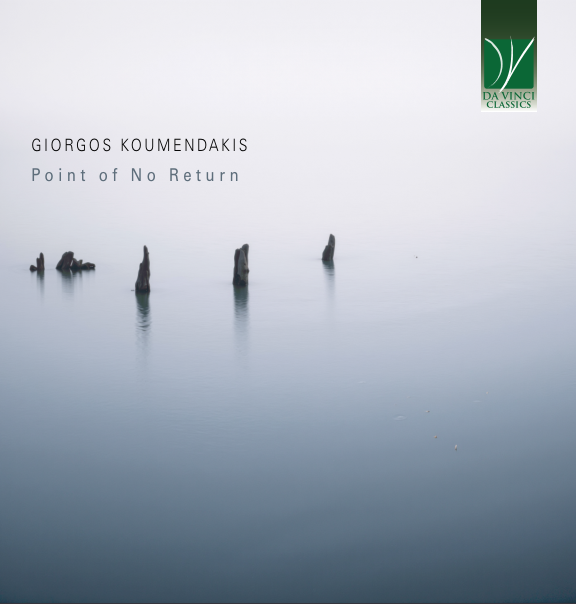
I am no great expert on contemporary Greek music, let me state that at the outset to avoid any misunderstanding; yet after listening to this CD, newly released by Da Vinci Classics, I became convinced that the music of the Greek composer Giorgos Koumendakis deserves to be heard and considered with close attention. Indeed, one need only listen to this recording, entitled Point of No Return, to realise that here is a composer whose artistic approach stands out for both its originality and complexity. Let us begin with the title of the album, since the “point of no return” indicates and embodies the way in which Giorgos Koumendakis engages with Greek tradition: not as a repertory to be quoted or restored, but as material which, once filtered through memory and compositional thought, can no longer recover its original form. It is the tragedy of that which evolves and undergoes transformation, carrying with it a sense of abandonment as it searches—sometimes in vain—for a new destination, another safe harbour. This emerges clearly from an examination of the four works included on the album—following the running order, The Pedal Tone of a Middle-Aged Man (2009), Typewriter Tune (2006), Forget Me Not (2007) and Point of No Return (2020)—which reveal two complementary procedures. On the one hand, the source material remains recognisable even as it is transfigured; on the other, all that survives is its pulse, its ornamental profile or a ritual atmosphere. Binding and cementing the programme together is the saxophone, an instrument capable of moving from sound to breath, from song to roughness, and from an individual to a collective identity.
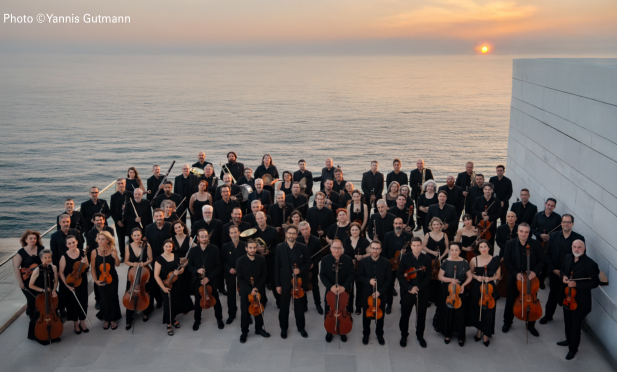
The Pedal Tone of a Middle-Aged Man, the Fourth Concerto for piano, saxophone quartet and strings, is the album’s centre of gravity. The reference to the ἴσον, or ison—the sustained, continuous vocal drone underpinning the melody in Byzantine chant—does not create an immobile background. Instead, the pedal tone acts as a force of attraction around which harmonies, rhythmic impulses and masses of sound gather and dissolve. Vassilis Varvaresos’s interpretation of the piano part emerges like a restless consciousness, now etching sharply defined figures, now scattering resonances, while the quartet forms a mobile band of sound that extends, colours or contradicts the strings. In this concertante work, Koumendakis constructs a form shaped by broad spans of musical breath, alternating feverish accumulations with sudden voids. The central cadenza, derived from a Thracian table song, is an area of suspended memory rather than a display of virtuosity. After the music regains its energy, the long epilogue shifts the perspective: the texture becomes rarefied, the registers darken, and finally the musicians’ voices take over the drone. In this way, ritual—one should never forget the theologising power emanating from Byzantine chant, sustained and embodied by the ἰσοκράτης (isokratis)—becomes a physical presence without lapsing into mere illustration. From an interpretative standpoint, Varvaresos approaches the piano part with lucidity and a finely judged control of weight, avoiding any temptation to turn its sudden gestures into mere effects. Conductor Konstantinos Terzakis likewise handles the proportions and transitions with assurance. At the same time, the strings of the Thessaloniki State Symphony Orchestra become, by turns, a granular surface, a harmonic foundation and a compact body of sound without ever overwhelming the winds, while the Osmosis Saxophone Quartet preserves the distinct identity of its four timbral voices even in the densest passages.
Typewriter Tune compresses a nervous instrumental theatre into barely ten minutes. The Cappadocian Koniali, a dance evoked through the prism of John Cassavetes’s marvellous and relentless film Faces, initially emerges as a shared impulse: short cells, cutting accents and almost mechanical interlocking patterns. Very soon, however, this regularity is disrupted by abrupt halts and wrenching expansions. The writing unfolds in blocks, like a dialogue in which each voice interrupts or distorts the others, symbolising a breakdown in communication—here the connection with the American director’s film resurfaces—that cannot be overcome. Thus, torn melodic lines, multiphonics, breath sounds and changes of register are set against homorhythmic compactness. The typewriter invoked by the title is therefore suggested in a manner that is less onomatopoeic than syntactic, through its keystrokes, erasures and resumptions. The extensive final coda dismantles the opening dance, leaving behind an unrecognisable yet still pulsating outline. Here, too, the Osmosis Saxophone Quartet contributes pinpoint attacks, secure intonation and a rhythmic command that never becomes rigid.
The three sections of Forget Me Not reduce the forces to Theofilos Sotiriades’s alto saxophone, but not the music’s variety of sound. The tsamikos, the Greek folk dance in 3/4 that serves as the work’s umbilical cord, remains beneath the surface, as though it were intended to embody a physical memory of the dance step rather than a straightforward ethnomusicological quotation. The first movement alternates isolated calls, broken phrases and flourishes; the second traces a more continuous arc, driven towards an almost vocal intensity; the third brings rhythmic gesture and song together in a fractured trajectory, in which each repetition changes its accent and colour. The ending offers no resolution—this, I believe, is a fundamental feature of Giorgos Koumendakis’s creative syntax—but instead withdraws. Sotiriades, to whom the work is dedicated, masters its sonic vocabulary without ostentation: his tone production is focused, his pianissimos stable, and his harmonics and microtonal inflections seamlessly integrated. Above all, he makes audible the continuity between extended technique and lyricism.

Finally, Point of No Return, originally composed for string quartet and transcribed by Antonis Fotiadis, brings the album to a close with a more expansive and contemplative synthesis. Here the sources are openly acknowledged, almost as though they constituted a programmatic manifesto: the Smyrneiko Minor and Manaki Mou, two songs from Smyrna that emerged during the 1920s. Yet a distinction must be made, for the melodic lines are not displayed like archaeological artefacts brought back into the light. Rather, they are recognisable in fragments, through ornamental curves and modal tensions, the latter immersed in harmonies that continually shift their centre of gravity. The element of breath introduced by the saxophones into the original version becomes a formal device: long phrases, suspensions and fresh departures lend the music a character that is at once processional and unstable. After a more compact opening section, the central part darkens and becomes increasingly rarefied. From this space there re-emerges a heightened form of song, almost a collective amanes—music steeped in emotional intensity and “femininity”—before the coda disperses the lines into echoes. It is interesting to observe how Koumendakis approaches the age-old encounter between East and West. In his conception, it is not resolved through decorative reconciliation but remains a fertile tension, entrusted to the almost organ-like quality of the ensemble’s sonority and, by contrast, to the individuality of each player’s breath. Here again, the Osmosis Saxophone Quartet offers a patient interpretation, finely balanced and capable of sustaining the music’s slow pace without ever losing direction.

At the end of this listening journey, one is left with the impression of a recording project of remarkable coherence, despite the chronological distance between the works and the diversity of their instrumental forces. Koumendakis does not simply superimpose a contemporary idiom upon folk materials: he brings to light what is already unstable, repetitive, ornamental and open to metamorphosis within the tradition itself. The excellent work of the Osmosis Quartet, Sotiriades, Varvaresos, Terzakis and the Thessaloniki State Symphony Orchestra renders this poetics tangible and persuasive. Point of No Return thus illuminates a particularly subtle and elusive idea: that of a modernity founded not upon the erasure of memory, but upon its irreversible transformation.
As regards the sound engineering, undertaken by George Rekoutis and Alexandros Raidis, the recordings were made during three separate sessions, in February, April and December 2024. In the piano concerto, recorded in the Ceremony Hall of Aristotle University of Thessaloniki, the reconstructed soundstage is broad and reverberant, with the strings retaining a convincing sense of depth. The piano is clearly present without being projected artificially into the foreground, while the quartet occupies a credible physical space. In the most complex full-ensemble passages, some inner detail merges with the surrounding acoustic, but this is the price paid for a coherent soundstage and an exceptionally wide dynamic range, which culminates naturally in the vocal epilogue.
The chamber works, recorded at the Greek National Opera’s recording studio, have closer, drier outlines, although the physical reconstruction of the musical event does not suffer as a result. The workings of the keys, the players’ embouchures and breathing, and the slightest differences in attack can all be heard clearly, while the stereo image remains stable even in the most tightly layered passages. The solo work benefits from analytical detail that never becomes intrusive, whereas in the quartets clarity does not come at the expense of blend. Moreover, the mastering preserves generous dynamic headroom and makes no attempt to impose a uniform volume across the different recording sessions. Finally, detail remains consistently precise and effective, while the performers possess a convincing three-dimensional presence, enhanced by the ample blackness of the acoustic background surrounding them.
Andrea Bedetti
Giorgos Koumendakis – Point of No Return
Vassilis Varvaresos (piano) – Osmosis Saxophone Quartet – Theofilos Sotiriades (saxophone) – Konstantinos Terzakis (conductor) – Thessaloniki State Symphony Orchestra
Da Vinci Classics CD C01207
Artistic rating 4,5/5
Technical rating 4/5