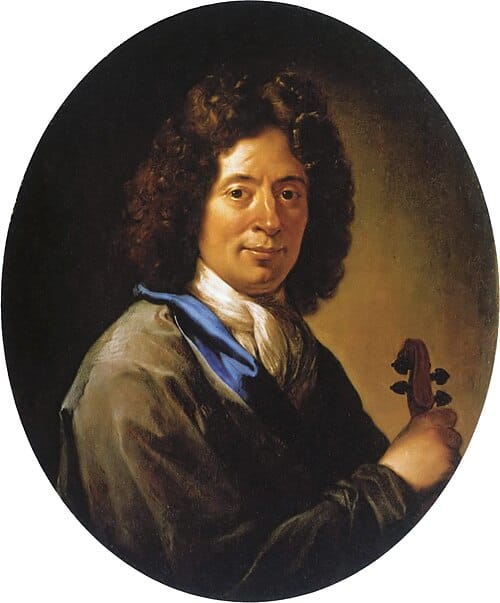
Few instrumental collections exerted an influence in the eighteenth century comparable to that of Arcangelo Corelli’s Opus Five. Published in Rome in 1700, the twelve Sonate a violino e violone o cimbalo enjoyed an extraordinary circulation throughout Europe, soon becoming not only a model of composition and violin writing, but also an inexhaustible source for appropriation, transcription, and transformation. It is precisely within this latter phenomenon that we should place the document on which this valuable recording, entitled Opera Quinta, made by the ensemble Il Pettirosso for the Da Vinci label, is based. Preserved in the Music Section of the Biblioteca Palatina in Parma as part of the Fondo Sanvitale, the manuscript transmits the first six Sonatas of Op. 5 in a version for recorder, presented here in its entirety for the first time on record.
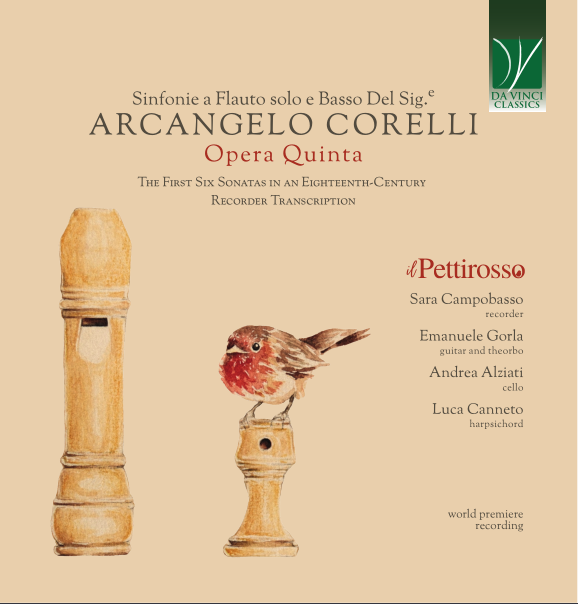
From a musicological standpoint, this is far from a marginal detail. The manuscript Sanv. D. 4/II, entitled Sinfonie à Flauto solo e Basso del Sig.e Arcangelo Corelli Opera Quinta, is, according to current knowledge, the only complete source for a recorder transcription of the first half of Corelli’s Op. 5. Its provenance leads us to Paolo Antonio Parensi (1688–1749), a member of a prominent patrician family from Lucca, who spent several formative years in Rome at the Collegio Clementino and was an amateur recorder player of considerable accomplishment. His music library, now represented by six manuscript volumes preserved in Parma, includes works by Giovanni Battista Sammartini, Francesco Barsanti, Robert Valentine, and numerous other composers, and offers a vivid picture of a tradition of private music-making that was anything but peripheral or naïvely amateurish.
This, in my view, is the first reason why the recording is of particular interest: what we hear is not simply Corelli “played on the recorder,” but Corelli filtered through a specific eighteenth-century musical culture. Indeed, the transition from the violin to a monodic instrument entails a genuine reshaping of the musical text. Thus, the First Sonata is transposed from D major to F major, and the Sixth from A major to C major; more significantly, in Sonatas I, II, III, and VI the second, fugal movements disappear, since their violin writing exploits polyphonic possibilities that cannot easily be transferred to the recorder. Elsewhere, the transcriber intervened directly in the musical material: in the Allegro of the Fourth Sonata and the Vivace of the Fifth, the closing bars were rewritten to achieve a more natural and idiomatic eloquence on the recorder. What we have before us, then, is not a transcription conceived according to the modern notion of fidelity to the original, but rather a process of assimilation: the work is adapted to another instrument while preserving its rhetorical identity rather than its literal text.
It is precisely this dimension that finds its decisive expression in the performance of recorder player Sara Campobasso. Her playing avoids both the temptation to imitate the violin and the opposite tendency to turn Corelli into a display of the instrument’s distinctive characteristics. Instead, the melodic line remains firmly anchored in the syntax of the phrase: attacks are clean without being hard, articulations finely detailed yet clearly perceptible, the emission carefully controlled, while a flexible dynamic range prevents the sound from becoming rigid. In the fast movements—the Allegro of the First Sonata, that of the Fourth, and the Vivace of the Fifth are particularly revealing—the young recorder player displays remarkable agility, but above all an ability to organize the figuration into coherent syntactical units. Nor does speed result in a uniform sonic surface: motifs, sequences, and cadences retain their hierarchical relationships, and it is precisely this ability to make the punctuation of the musical discourse perceptible that restores to the transcription some of the complexity that might otherwise inevitably have been lost with the abandonment of the violin’s polyphonic resources.
Even more significant is the approach taken in the slow movements. Here one of the recording’s central interpretative issues arises, since the Adagios in the Parensi manuscript contain no written ornamentation. Sara Campobasso and the guitarist and theorbist Emanuele Gorla therefore chose not to regard this absence as an invitation to an unadorned reading. Instead, they studied the embellishments found in the other volumes once owned by Parensi, treating them as evidence of a performance practice upon which the collection’s owner himself might have drawn. This was an important decision, since it shifts the issue away from the generic application of a “Baroque performance practice” towards the reconstruction of an ornamental vocabulary specifically relevant to the source. In performance, the result is convincing above all for its restraint: the ornamentation is not superimposed upon the melody as an external decoration but serves to intensify its expressive and cadential function. Thus, in the Grave and Adagio movements the recorder can linger over the phrase, inflect the melodic line, and enrich it as it approaches a cadence without ever obscuring the underlying Corellian framework. In this music, it is essential to remember that embellishment should seem to arise from the expressive needs of the melodic line rather than from the performer’s desire to demonstrate familiarity with historically informed practice. Campobasso succeeds in maintaining this balance, with phrasing that possesses a natural vocal quality and in which breathing itself becomes a structural element. On these terms, the transition from violin to recorder ultimately illuminates something already inherent in Corelli’s musical language: the extraordinary cantabile quality of a style of writing capable of sustaining ornamentation without being overwhelmed by it.
Equally crucial in this respect is the treatment of the basso continuo. The aforementioned Emanuele Gorla, on guitar and theorbo, Andrea Alziati on cello, and Luca Canneto on harpsichord do not provide a neutral backdrop to the solo part but rather create a constantly responsive musical texture. This allows for considerable variety in instrumental combinations and timbral balance, avoiding the monotony that a cycle of six sonatas for a melody instrument and continuo might otherwise easily generate. The guitar and theorbo thus introduce an element that is at once incisive and transparent; the cello lends depth and direction to the bass line, while the harpsichord reinforces the harmonic architecture without unduly occupying the acoustic space. In the fast movements, the continuo provides momentum without driving the recorder towards a merely mechanical brilliance; in the slow movements, by contrast, it becomes a genuine interlocutor with the upper line, through a carefully calibrated sense of harmonic breathing.
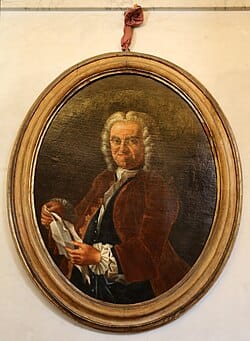
Particularly illuminating is an ideal comparison between the beginning and the end of this journey. Sonata I, transposed into F major, immediately introduces the listener to a sound world in which Corelli’s authority is lightened without being diminished or reduced in scale. By the time we reach Sonata VI, transposed into C major, our acquired familiarity with this different sonic identity of the work allows us to appreciate how much less innocuous the operation is than it might initially appear: by altering register, articulation, and polyphonic possibilities, the transcription inevitably changes the perspective from which we perceive the composition, yet the solidity of its architecture remains intact. Indeed, the transcription brings into particularly sharp focus Corelli’s music’s ability to withstand the transformations inherent in the very act of transcription.
It is no coincidence that the Parensi collection is also an important document for understanding the circulation of repertory in the eighteenth century. Its manuscripts contain other transcriptions of compositions originally intended for the violin, and the booklet notes, written by Emanuele Gorla and Sara Campobasso themselves, rightly emphasize how these sources bear witness to the permeability between instrumental idioms and to the active role played by adaptation in domestic music-making. The very concept of the musical “work” thus emerges as less fixed than the one to which nineteenth- and twentieth-century musical culture has accustomed us: a composition could circulate, change instrument, key, internal structure, and ornamentation, while continuing to be recognized as the work of its original composer.
The greatest merit of this recording project from Da Vinci Classics lies, in my view, in avoiding the temptation to make the label world premiere recording its principal claim to distinction. The recording première is certainly significant—as the booklet explicitly states—but even more important is what this document enables us to understand. Moreover, the ensemble Il Pettirosso offers neither an “antiquarian curiosity” nor a Corelli merely clothed in different instrumental colours; rather, it reconstructs a possible eighteenth-century reading of Opus Five. And this is perhaps the most fascinating aspect of the entire project: between the text of 1700, the anonymous hand that adapted it to the requirements of the recorder, Paolo Antonio Parensi’s library, and the present-day performers, a chain of mediations emerges through which Corelli’s music appears not as a relic to be restored to some presumed original immutability, but as a living organism continually transformed by its history of reception.
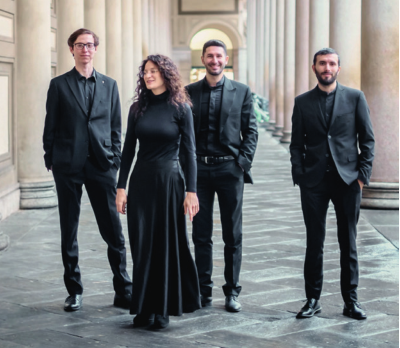
The assessment of the recording quality, performed by Gabriele Zanetti, is equally positive. The dynamic range, in terms of both energy and transient response, provides the instruments with an appropriate degree of definition and individual recognizability. As regards the soundstage, the spatial reconstruction of the ensemble is coherent, with an overall image that remains suitably intimate and chamber-like. This suggests that the microphones were not placed excessively close to the instruments, thereby allowing the sound to develop convincingly in both height and width. The tonal balance and level of detail further contribute to the excellence of the recording: the former reveals no anomalies or problematic overlapping of instrumental registers, while the latter is particularly impressive in terms of three-dimensionality and the precise focus of the ensemble.
Andrea Bedetti
Arcangelo Corelli – Sinfonie à Flauto solo e Basso del Sig.e Arcangelo Corelli Opera Quinta
Ensemble Il Pettirosso
Da Vinci Classics CD C01213
Giudizio artistico 4,5/5
Giudizio tecnico 4/5