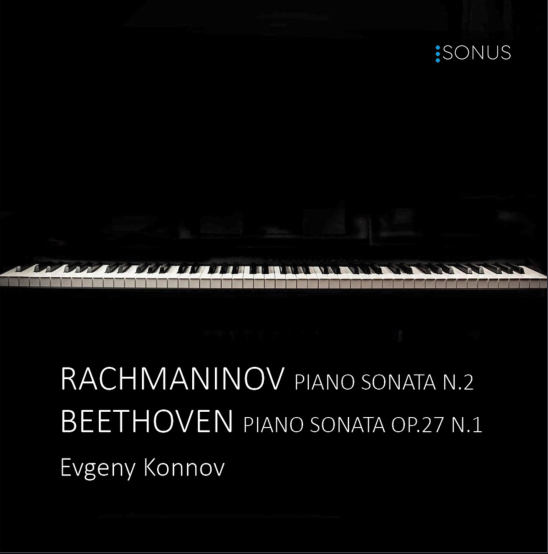
The historical trajectory of the sonata-form represents, for the observer of the evolution of musical languages, one of the most fascinating and, at the same time, most slippery and perilous fields of inquiry. Over the course of a century and a half, this formal archetype transitioned from being the guardian of a geometric and dialectical rigor to becoming a hypertrophic vessel, at times saturated with an expressiveness that risked suffocating its very structural foundations. The recent digital release on Spotify, performed by the young Uzbek pianist Evgeny Konnov, winner of the 12th edition of the Verona International Piano Competition in 2024, and dedicated to a program pairing Sergei Rachmaninoff’s Sonata No. 2 in B-flat minor, Op. 36 with Ludwig van Beethoven’s Sonata in E-flat major, Op. 27 No. 1, offers an opportunity for reflection on this precise aesthetic watershed. This pairing is not merely a chronological contrast, but a genuine duel between two antithetical conceptions of the keyboard and of musical narrative.
The first consideration prompted by this pairing is that of a profound split in taste and in the philosophy of interpretation. On one hand, the genius of Bonn, who dismantles form from within out of sheer speculative and inventive necessity; on the other, the late-Romantic Russian epigone, whose writing has always raised legitimate aesthetic doubts in those who, like me, favour conceptual density over ornamental redundancy. Within this context, Konnov’s undertaking proves to be of utmost critical interest, as the young pianist finds himself having to govern two radically divergent sonic worlds, searching for a guiding thread that never devolves into hermeneutic compromise or empty virtuoso display.
Now, those who regularly follow my critical work are perfectly aware of my near-total repugnance toward Rachmaninoff and his aesthetic-musical conception. After all, it is impossible to approach his Second Sonata without a dose of severe critical skepticism (and today I feel strangely kind and indulgent). Composed in 1913 and subsequently revised in 1931 in an attempt (only partially successful) to lean out its original, turgid density, Op. 36 exemplarily embodies all the limitations of an aesthetic that turned sonic gigantism and exacerbated sentimentalism into its own stylistic hallmark. I have always stigmatized Rachmaninoff’s music because it frequently moves along a perilous ridge, where the unrestrained accumulation of materials, transcendental virtuosity as an end in itself, and melodies steeped in a nostalgic lyricism ultimately generate a fragmented narrative, devoid of that stringent architectural logic that renders Viennese Classicism—to which Beethoven belongs—immortal by contrast.
The Sonata in B-flat minor presents itself as a disproportionate cathedral of sounds, a work in which the performer is called upon to disentangle themselves from cascades of chords, saturated polyphonic textures, and an expressive anxiety that saturates every single inch of the staff. The risk inherent in these pages is a descent into sonic chaos, into the self-indulgence of a muscular virtuosity that flattens dynamics and transforms listening into an exhausting experience. The first movement, Allegro agitato, opens with a descending theme that immediately saturates the acoustic space—a theatrical declamation that seeks grandiosity through volumetric amplification rather than rigorous thematic development. There follows the Non allegro, a central movement that constantly flirts with a patheticism redolent of salon music, albeit disguised as a magniloquent symphonic fresco, only to culminate in an Allegro molto finale that exacerbates the logic of motoric accumulation and percussiveness.
Fortunately for us, mitigating the damage of this sonic hotchpotch is Evgeny Konnov’s interpretation, which emerges with a force that is nothing short of millimetre-precise. The young Uzbek pianist does not commit the age-old mistake, unfortunately common among many performers of the Slavic school, of throwing himself headlong into cheap sentimentalism or muscular exhibitionism. On the contrary, Konnov approaches Op. 36 with an almost geometric lucidity, an analytical control that acts like a scalpel upon an otherwise amorphous sonic mass. His articulation is of a crystalline transparency: even in the densest passages of the first movement, where the atrocious overlapping of voices risks producing a muddy blend in which to get bogged down, Konnov manages to isolate the secondary contrapuntal lines, restoring an unsuspected structural clarity. His is not a shouted Rachmaninoff, thank goodness, but a Rachmaninoff deconstructed and reassembled with the objectivity of a modern architect. In the central movement, furthermore, the sustenance of his phrasing avoids the traps of tearful rhetoric, maintaining a rhythmic rigor and a nobility of touch that ennoble, as far as possible, the raw material.
Faced with such compositional poison, a potent antidote was required, represented in this case by Beethoven’s Sonata in E-flat major, Op. 27 No. 1. Published in 1801 alongside its twin and far more famous Op. 27 No. 2 (the so-called Moonlight, a title that has caused more damage in hindsight than a bubonic plague), this page bears the fundamental indication Quasi una fantasia. This rubric, let it be perfectly clear, does not represent a surrender to formal anarchy, but rather the exact opposite: namely, the assertion of a supreme poetic freedom that reinvents the rules of the game from within, without ever losing sight of the organic unity of the cycle.
Through this keyboard page, Beethoven dismantles the traditional succession of movements and imposes an uninterrupted narrative flow (attacca), in which the individual parts merge into a single, grand dramatic organism. There is no room here for decorativism or calligraphic display; every note, every silence, every agogic shift answers to an ironclad expressive and structural necessity, with a deployment of the sonic material to be moulded that is nothing short of parsimonious—as was customary for the genius of Bonn. The opening with an Andante in duple time, interrupted by a central flash in Allegro, is a clear statement of intent: indeed, the renunciation of the traditional sonata-form in the first movement catches the listener off guard, leading them into a territory of lyrical candour and sudden inventive freshness. The Allegro molto e vivace that follows is a nocturnal, febrile scherzo, based on broken arpeggios that require absolute dynamic control so as not to turn into a mere mechanical exercise. Yet it is in the Adagio con espressione that the summit of poetic tension is reached—a page of absolute interiority that prepares the complex transition toward the final Allegro vivace, a rondo-sonata of extraordinary polyphonic density, where the main theme is subjected to a stringent development, crowned by the fleeting reprise of the Adagio before the sweeping final stretta.
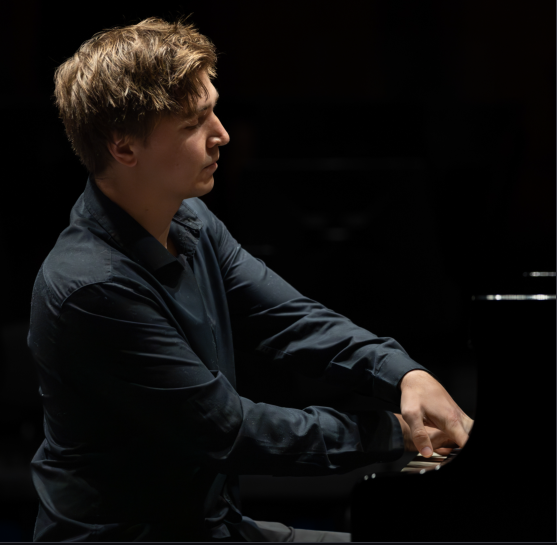
In this masterpiece of formal economy and speculative audacity, Evgeny Konnov offers a demonstration of the highest interpretive maturity. The pianist captures the "experimental" spirit of this masterpiece with painstaking precision. His touch in the opening Andante possesses a composed, almost Apollonian grace, devoid of those proto-Romantic temptations that would alter its correct historical placement. The fluidity in the shifts of register and the management of dynamic chiaroscuro reveal a profound study of the Beethovenian sound, which is never ethereal but always physical—rooted in the earth even when it rises toward moments of pure abstraction. In the finale, the clarity with which Konnov unravels the complex contrapuntal framework demonstrates a technical mastery that transforms into musical thought. The dramatic transition, the choice of tempo, and the balance between the left and right hands restore a tense, profoundly modern Beethoven—a titan who dominates form with the intellect even before sentiment.
I find that the primary characteristic emerging from this recording is the capacity to impose an intellectual order upon emotional chaos. Faced with a program that could easily have slipped into incoherence or mere concert eclecticism, Konnov demonstrates that it is possible to find a middle ground between rigorous analysis and interpretive sensitivity.
Granted that in this case I am making an exception, given the calibre of the young Uzbek pianist, as I do not usually consider audio tracks destined for the Spotify platform—which do not necessitate a faithful, audiophile sound reproduction—the recording engineered by the Audio Classica studio, specifically by its head Filippo Lanteri for the Sonus label, although dynamically crisp, lean, and with an acceptable speed, presents itself as tailored precisely ad usum for the platform in question, whose commercial philosophy relies more on the quantity of recordings than on the sound quality itself. Given also the reduced size of the audio tracks, even though I listened to them in WAV format, one notices a certain "rounding off" in the peaks of both the high and low registers, precisely to meet Spotify's "quantitative" demands. And this is a pity, since the equipment used by Audio Classica to capture the recordings is undoubtedly top-tier, capable of guaranteeing a quality also intended for a technically and musically more sophisticated audience.
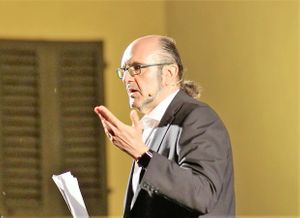
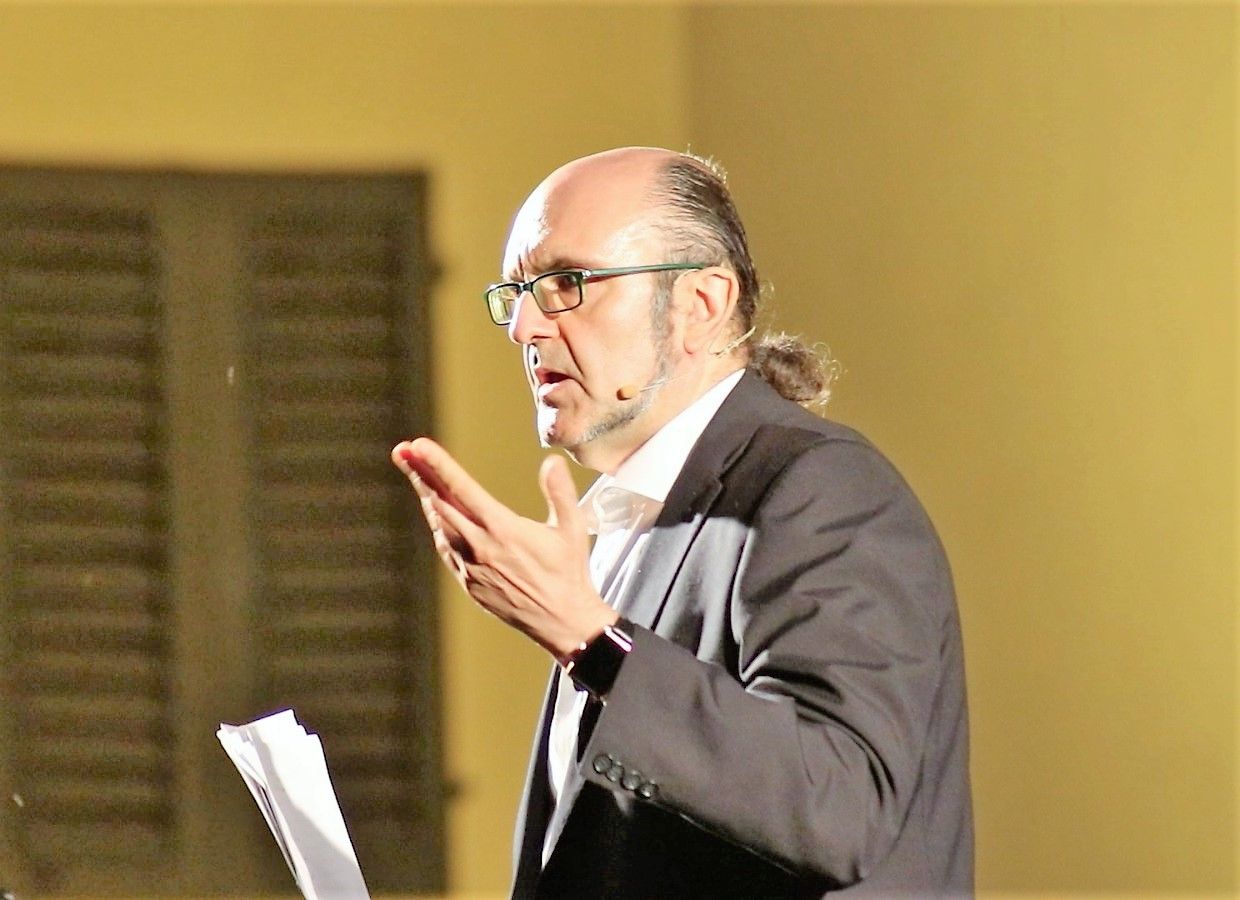
Andrea Bedetti
Rachmaninoff-Beethoven – Piano Sonata No. 2 / Piano Sonata Op. 27 No. 1
Evgeny Konnov (piano)
Sonus Digital Tracks
https://www.spotify.com/it/
Artistic rating 4,5/5
Technical rating 3/5