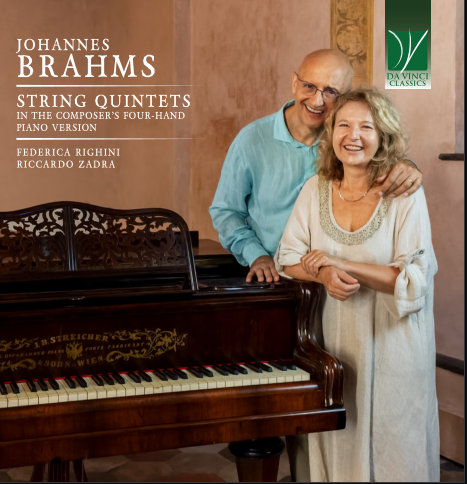
Within Johannes Brahms’s vast recorded catalog, it is rare to come across a project that successfully combines philological interest, historical value, and a genuinely fresh listening experience. This is precisely the case with this CD released by Da Vinci Classics, featuring the transcriptions for piano four-hands of the two String Quintets Op. 88 and Op. 111, crafted by the great Hamburg master himself and performed here by the piano duo of Federica Righini and Riccardo Zadra. These pieces remain almost unknown to the general public and are only occasionally encountered even among performers, despite fully belonging to Brahms’s creative workshop and serving as a precious testament to his conception of musical writing.
Indeed, after listening to this recording, I am firmly convinced that the most compelling aspect of this release lies in its invitation to overturn a deeply rooted prejudice. Even today, the term “transcription” is often interpreted as a synonym for reduction, adaptation, or an inevitable compromise with the original. Such a perspective, however, is alien to nineteenth-century musical culture and, in particular, to the Brahmsian conception of composition. For Brahms, transcription was not an "accessory" operation, aimed solely at promoting the commercial circulation of his works, but a true instrument for reflecting upon the musical material itself. If I were to draw a comparison with other masters who frequently resorted to the practice of transcription, I would argue that while Liszt transcribed to “amplify,” Busoni transcribed to “recreate,” and Mahler retouched to “correct,” Brahms, by contrast, transcribed to “understand.”
To transcribe by altering the instrumental forces means to observe the same architecture from a different point of view, verifying its solidity, the balance of its proportions, and the coherence of its contrapuntal design. Modern musicology has rightly emphasized this perspective on multiple occasions. Walter Frisch, for instance, has demonstrated how, within Brahms’s aesthetics, the coherence of motivic construction precedes any timbral determination: the identity of a work resides primarily in the logic of its organic growth. Consequently, the composer’s own transcriptions serve as a testing ground for the structural integrity of the composition, rather than a mere reduction intended for the publishing market, as previously mentioned.
This conviction accompanied Brahms throughout his entire creative life. In this regard, one need only recall the tormented evolution of the Quintet Op. 34, which was first conceived as a string quintet, subsequently transformed into a Sonata for two pianos, and ultimately arrived at its definitive form as a Piano Quintet. Here, we are not dealing with simple "revisions," but with genuine compositional metamorphoses, in which the change of instrumentation became an opportunity to rethink the internal balance of the work itself. Similarly, the numerous versions for piano four-hands of the symphonies of Ein deutsches Requiem, and of other orchestral works do not merely satisfy the demands of long-standing publishing distribution; rather, they reflect a deeply rooted idea that the substance of music must be able to exist independently of instrumental colour. In this sense, the piano occupied a privileged position for Brahms (and others). Indeed, no other instrument possesses the capacity to condense the complexity of an entire polyphonic construction onto a single sonic surface. The keyboard thus becomes a sort of "analytical laboratory" in which harmony, counterpoint, and form present themselves in their absolute essence—stripped of timbral seduction, yet, for this very reason, revealed with greater clarity.
This is why it should come as no surprise that Brahms attached decisive importance to the piano four-hands. Nowadays, unfortunately, this repertoire is frequently relegated to the realm of domestic or pedagogical literature, but in the second half of the nineteenth century it represented one of the primary vehicles for the dissemination of art music. Before the advent of phonographic recording, getting to know a symphony often meant playing it at home, reading it through with other musicians, and studying its construction via a keyboard reduction. In short, the practice of so-called Hausmusik was not merely a refined bourgeois pastime: it was, instead, a way of culturally internalizing the musical work itself.
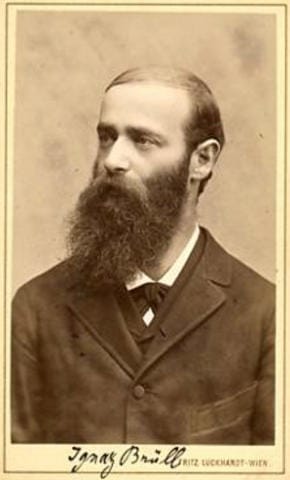
Furthermore, to underscore this distinctive feature, it is worth remembering that Brahms himself regularly participated in these private performances. The presentation of the Third Symphony in the version for two pianos, performed with Ignaz Brüll before a small circle of friends a few days before the world premiere conducted by Hans Richter, remains famous. This episode is revealing of the function attributed to transcription: not a mere surrogate for the orchestra, but a testing ground on which to verify the efficacy of the musical construction before its public exposure. Indeed, the British musicologist and pianist Donald Francis Tovey had astutely observed how the greatness of Brahms’s writing lay in its independence from the instrumental medium: timbre alters the listening perspective but does not change the internal logic of the construction.
The versions for piano four-hands of the two String Quintets recorded on this Da Vinci CD by Federica Righini and Riccardo Zadra belong fully to this conception. They did not come to life many years after the originals as independent publishing operations; rather, they accompanied their publication by Simrock almost immediately, entering the performance history of both works from the very beginning. The existence of a dual version, both authorized by Brahms himself, thus suggests abandoning the misleading notion of a hierarchy between original and derivation. Instead, there exist two different modes of access to the same musical construction. It is precisely this perspective that makes the recording project in question particularly significant, as the listener is not invited to constantly compare what the piano "loses" in relation to the strings, but rather to discover what the keyboard manages to bring to light. While the allure of the strings derives largely from the continuity of the bow, the flexibility of the vibrato, and the unceasing shaping of the sound, the piano instead compels the attention to focus on the harmonic framework, the distribution of the inner parts, the contrapuntal lines, and the overall breath of the form.
This represents a shift in perspective that profoundly alters our way of listening to Brahms, as the density of his writing—often perceived as a compact sonic mass—suddenly acquires an unexpected transparency. The inner voices emerge with clarity, the imitative processes are naturally distinguished, and the constant rhythmic and metric shifts gain an almost analytical legibility without sacrificing the expressive warmth of the piece. After all, no nineteenth-century composer quite like Brahms was able to reconcile the severity of contrapuntal construction with the most intense Romantic cantabile: behind every seemingly spontaneous episode lies a dense network of motivic relationships, internal references, thematic transformations, and formal correspondences. Consequently, the piano transcription, far from impoverishing this complexity, tends instead to illuminate it, offering the listener an almost "X-ray" perception of the composition.
It is significant that the Quintets Op. 88 and Op. 111, separated by nearly a decade and belonging to two distinct creative periods, offer such an eloquent demonstration of this dual nature of Brahms’s language. The former still belongs to the full maturity of the 1880s, when the composer seemed to achieve a perfect balance between Classical rigor and inventive fantasy; the latter, by contrast, already looks forward to the world of the late chamber works, in which the concentration of discourse and the continuous transformation of thematic material foreshadow the increasingly lean writing that would characterize the final years of his production.
While the two Quintets share an adherence to the same genre and the existence of a parallel piano version, they nevertheless reveal two different moments in Brahms’s creative trajectory. The Quintet in F major Op. 88, composed in the summer of 1882 in the tranquillity of Bad Ischl, belongs to a period of particularly serene inventiveness. The author himself defined it, with uncharacteristic satisfaction, as a Frühlingsprodukt—a "spring product"—as if to emphasize not only the speed of its composition but also the luminous character of the work. Critics, with good reason, have frequently insisted on the autumnal dimension of Brahms’s language, which is often dominated by an absorbed melancholy and a constant sense of memory; precisely for this reason, Op. 88 constitutes a fascinating exception, dominated instead by an expansive cantabile and a thematic freshness that even Hugo Wolf, who despised Brahms’s music, recognized as unusual. The transcription for piano four-hands allows us to grasp the extraordinary economy of the writing with particular clarity. Stripped of the allure of string timbre, the music reveals the impressive coherence with which every element derives from the preceding one. There are no ornamental or merely decorative episodes: every transition possesses an autonomous expressive function, and every development arises from the organic transformation of the initial material, in accordance with the principle of entwicklende Variation—"developing variation"—which constitutes one of the cornerstones of Brahmsian aesthetics. At the keyboard, all of this emerges with an almost pedagogical clarity, yet without compromising the natural fluidity of the musical discourse. In this sense, Brahms gathers and renews the Beethovenian legacy through a process that Arnold Schoenberg would later famously define precisely as "developing variation," identifying Brahms’s output as one of the pinnacles of modern compositional thought.
In this way, the continuous transformation of thematic material becomes the unifying principle of the entire musical architecture. Even more astonishing is the central movement, in which Brahms concentrates the functions traditionally assigned to the slow movement and the scherzo into a construction of exceptional originality. The constant alternations of character, the dialogue between contrapuntal severity and dancing lightness, and the references to early music interwoven with a fully Romantic style of writing acquire a structural clarity in the piano version that the strings—with their natural timbral homogeneity—tend inevitably to blend into a single sonic atmosphere. It is no coincidence that many passages assume almost the appearance of an "open" score, in which it becomes possible to simultaneously follow the path of individual melodic lines and that of the harmonic construction.
Eight years separate this masterpiece from the Quintet in G major Op. 111, Brahms’s last great chamber composition for strings alone, and a work that in many respects seems to summarize an entire creative period. Indeed, the English musicologist Michael Musgrave, a leading expert on the Hamburg master's music, has observed that the works of late Brahms manifest an increasing tendency toward the concentration of musical discourse—not a simplification of language, but rather its progressive internalization. The Quintet Op. 111, while retaining an almost symphonic grandeur, likewise reveals this tension toward an expressive essentiality that would characterize his final chamber masterpieces. Here, the writing achieves an almost symphonic monumentality. Musicology has long noted that part of the material derived from sketches intended for a projected Fifth Symphony, which was never completed. Whether or not this hypothesis is decisive, the fact remains that Op. 111 possesses an exceptional architectural scope, so much so that it frequently transcends the traditional boundaries of chamber music.
It is precisely in a piece of such density that the piano transcription demonstrates its full artistic legitimacy. The powerful opening of the first movement, entrusted in the strings to a compact and enveloping sonic mass, is transformed on the keyboard into a construction of astonishing sharpness, in which the relationships between the different layers of the writing are immediately perceptible. The transcription acts like an anatomical cross-section of the score: with the unrepeatable allure of the timbre stripped away, the balance of the sonic masses, the distribution of the harmonic planes, and that continuity of motivic growth—the true organizing principle of Brahmsian writing—surface with striking clarity. The subsequent Adagio also benefits from this new perspective: its poised gravity, the almost processional stride of the phrases, and the continuous alternation of harmonic tension and release acquire a singular intensity precisely due to the percussive nature of the piano. This forces the performers to build the melodic line solely through the weight of the sound, the articulation, and the breath of the phrase, without being able to rely on the natural expansion of the bow. It is a different form of eloquence—perhaps more austere, yet no less persuasive. The Finale definitively confirms the modernity of these transcriptions. The rhythmic energy, the echoes of the style hongrois, and the mastery with which Brahms blends rondo and sonata-allegro forms find an extraordinarily effective vehicle in the keyboard. Once again, the piano does not attempt to imitate the strings; instead, it proposes a different mode of listening, in which the internal dynamism of the form prevails over purely timbral seduction.
Naturally, all of this requires performers capable of approaching these pages not as mere bibliographical curiosities, but as genuine masterpieces of the piano repertoire. This is the primary merit of the Righini-Zadra Duo, who demonstrate from the very first bars a profound internalization of the Brahmsian style. The dominant impression is not that of two excellent pianists sharing the same keyboard, but rather of a single musical organism capable of breathing with absolute naturalness. The phrasing always maintains a broad narrative arc; the large harmonic progressions unfold with inevitable logic; and the manifold inner voices, so decisive in Brahms's writing, emerge without artifice, integrated into a sonic balance of rare maturity. Furthermore, the decision to eschew any virtuosic temptation is particularly convincing. It would have been easy to transform these transcriptions into a display of pianistic brilliance. Instead, fortunately for us, the performers have wisely chosen a diametrically opposed path, prioritizing the clarity of the polyphonic fabric, the quality of the legato, and the continuity of the formal construction. This approach is perfectly coherent with the poetics of Brahms—a composer who distrusted all spectacular outward display and entrusted expressiveness to the internal logic of the musical discourse.
Another factor that should not be underestimated is the decisive role played by the choice of instrument. Indeed, the deployment of an 1860 Streicher piano is neither a mere antiquarian homage nor a concession to the fashion of historically informed performance; rather, it serves as an essential interpretative element. Brahms intimately knew the instruments made by the Streicher firm, as he regularly used them for composing and recognized in them timbral characteristics that were particularly congenial to his own writing. The transparency of the registers, the responsiveness of the mechanical action, and the chromatic variety of the sound allow here for a reading in which Brahmsian density never degenerates into opacity. Furthermore, compared to the modern piano, the Streicher offers a palette that is less monumental but infinitely more differentiated. The middle lines acquire a natural prominence, the basses maintain a precise definition without invading the overall fabric, and the treble avoids any annoyingly "metallic" brilliance. The resulting sonority is thus surprisingly close to Brahms's chamber ideal, in which the quest for balance consistently prevails over effect. As the British composer and pianist Malcolm MacDonald rightly pointed out, Brahms conceived of pianistic sound not in terms of volume, but of harmonic density and balance between the parts. From this point of view, a historical instrument like the Streicher does not constitute a philological affectation, but rather an "hermeneutic" tool capable of restoring that transparency of the polyphonic texture which the modern piano sometimes tends to homogenize.
From what I have endeavoured to explain so far, it is evident that the overall result of this recording goes far beyond mere documentary interest. We are not dealing with the rediscovery of a curiosity intended exclusively for specialists, but with a genuine interpretative proposal that invites us to rethink the very meaning of transcription in nineteenth-century musical culture. Listening to these Quintets in their pianistic guise means understanding how Brahms conceived his music beyond instrumental specificity, entrusting its identity not so much to sonic colour as to the strength of the construction, the richness of motivic invention, and the extraordinary compactness of the formal architecture. What I have outlined throughout this essay also represents an implicit and unconditional praise for the work achieved by the piano duo of Federica Righini and Riccardo Zadra. If I have dwelt at length on the value and importance of transcription within the Brahmsian aesthetic and sonic universe, it is for the simple reason that, through their visionary reading, the two pianists have succeeded in turning it into an exemplary blueprint for post-listening reflection. And when a performance allows a speculative reflection to blossom, it means that the execution has perfectly hit the mark. The apparent timbral sobriety is in reality a continuous process of decoding—an internalization of a sonic material that never for a single moment ceases to shape and proclaim itself.

In an era like ours, in which listening is often dominated by the pursuit of timbral effect and executive showmanship, the interpretation of Federica Righini and Riccardo Zadra restores a more intimate and meditative dimension to the music. It invites the listener to step into the composer's workshop, to follow his constructive processes, and to grasp the unceasing dialogue between tradition and innovation that runs through Brahms's entire output. Thus, at the end of the listening experience, one is left with the sensation of having encountered not two works different from those we already knew, but two pieces observed from a fresh perspective, like a famous building illuminated by an unexpected light. This is the privilege that only great transcriptions can offer: not to replace the original, but to reveal its hidden aspects. And this is precisely what Brahms, with his usual and brilliant lucidity, had understood from the very beginning, delivering versions that still surprise today with their intelligence, naturalness, and profound artistic necessity. This is why, thanks to this piano duo, the transcriptions for piano four-hands of the Quintets Op. 88 and Op. 111 represent the ideal complement to the originals—a second perspective from which to contemplate one of the absolute pinnacles of European chamber music.
Preserving and restoring the unique timbre of the Streicher piano was the primary technical task in the audio engineering carried out at the Studio Barletta in Chiavari. It is a pity that the person responsible for this work is not credited in the inlay card, as the result of this recording is undoubtedly of an excellent standard. This begins with the dynamic parameter, characterized by great cleanliness, through which the Streicher’s timbre is offered in all its magnificence, bolstered by speed, naturalness (one might even want to define it as "pristine clarity"), and appropriate transient response. The soundstage reconstructs the instrument at a discrete depth, sculpted between the loudspeakers, with a generous amount of width and height of sound, without showing the slightest graininess. Tonal balance in a recording for piano four-hands is delicate, to say the least, but here the lower-middle and treble registers are always perfectly distinguishable in terms of focus and mutual non-intrusiveness. Finally, the detail captures the three-dimensionality of the Streicher, with a spatial definition that enhances the virtual presence of the instrument within the listening environment.
Andrea Bedetti
Johannes Brahms – String Quintets in the Composer’s Four-Hand Piano Version
Federica Righini & Riccardo Zadra (piano)
CD Da Vinci Classics C01172
Artistic rating 5/5
Technical rating 4,5/5