Disc of the Month of October 2026
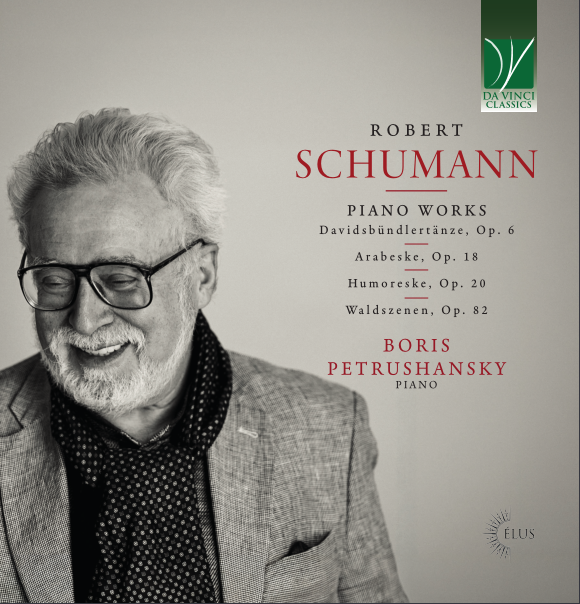
There are interpreters who approach Schumann by emphasizing his fractures, heightening the contrast between impetuosity and withdrawal, between Florestan’s feverish extroversion and Eusebius’s pensive introspection; yet there are others who, without diminishing that radical duality, seek instead the deeper point at which the two figures communicate and ultimately come almost to recognize one another as emanations of a single consciousness. The Russian pianist and teacher Boris Petrushansky decidedly belongs to this second category, and in the recently released double CD issued by Da Vinci Classics in its Élus series, devoted to four cornerstones of Schumann’s piano literature — Davidsbündlertänze, Op. 6, Arabeske, Op. 18, Humoreske, Op. 20, and Waldszenen, Op. 82 — he does not turn the keyboard into a stage for external contrasts, but rather into a mental space in which gestures, memories, images, and emotions emerge from one another according to an essentially inward logic.
This is a crucial point, because it is precisely here that one of the fundamental questions of Robert Schumann’s pianistic aesthetics is at stake. Few composers have transferred into sound, with comparable radicalism, the Romantic sense of a divided consciousness. In Schumann, form is almost never a framework within which events are placed; rather, it is the provisional result of their very unfolding, with musical thought proceeding through apparitions, returns, interruptions, memories, and sudden illuminations. Seen in this light, the miniature, the fragment, and the aphoristic character do not represent a renunciation of large-scale form, but a different way of conceiving it, since unity arises from memory and from the hidden relationships linking what, on the surface, appears discontinuous.
This conception demands of the interpreter something quite different from the mere ability to characterize a succession of episodes, since one must recognize what survives from one fragment to the next, what is transformed, and what returns as reminiscence; above all, one must possess a sense of that singularly Schumannesque temporality in which present experience and memory seem constantly to overlap. It is precisely within this dimension, as I hear it in the present recording, that Petrushansky’s interpretation finds its deepest raison d’être.
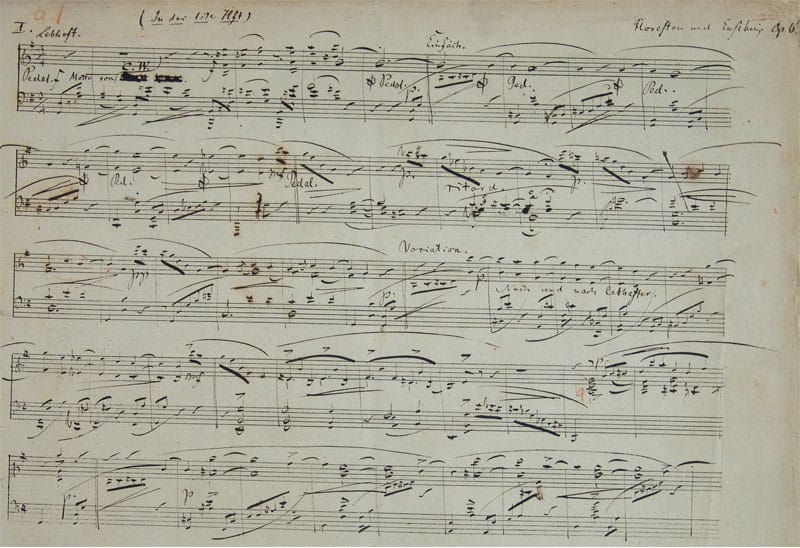
The Davidsbündlertänze, Op. 6, perhaps represent the most evident laboratory of this poetics. Behind the fiction of the League of David, ranged against the “Philistines” of the musical world, stand the two complementary projections of Schumann’s personality: Florestan and Eusebius. Impulse, ardour, and rhythmic restlessness on the one hand; rêverie, song, and inward contemplation on the other. Yet the greatness of the work lies precisely in the fact that their opposition never remains schematic: the two characters permeate one another, observe one another, and at times seem almost to exchange roles. From the very first dance, Lebhaft, symbolically entrusted to both, Petrushansky makes this ambivalence immediately perceptible.
His opening possesses energy without brutality; the rhythm is clear-cut without becoming percussive, and the phrasing retains a flexibility that prevents the pulse from hardening. Already here one perceives a trait that will characterize the interpretation as a whole: Petrushansky never confuses energy with weight. Even when the writing calls for impetus and density, the sound preserves an inner elasticity of its own. The chords are not hammered into the keyboard; rather, they participate in the broader movement of the phrase. This, in my view, is a deliberate interpretative choice, for it rescues Florestan from the caricature of sheer impetuosity and restores to him that visionary dimension which is equally integral to his nature.
One need only move on to the ensuing Innig to understand the other side of the matter. Here time seems to expand without ever coming to a halt. Petrushansky possesses a singing quality that does not depend on an indiscriminate use of legato or pedal, but on his ability to establish precise hierarchies among the voices. In this way, the melodic line emerges without being isolated from the harmonic fabric that sustains it; the left hand does not become accompaniment in the conventional sense, but rather the ground from which the melody itself seems to arise. There is an almost vocal quality to the phrasing, yet one wholly devoid of sentimentality. Eusebius, it must be made clear, is not languor: he is listening.
The contrast with Ungeduldig might easily become violent, yet Petrushansky once again avoids any kind of didactic overstatement. The sense of impatience arises from the articulation, from the compression of the gesture, from the urgency with which one figure seems to propel the next. There is no need for arbitrary accelerations or overcharged accents, since the character is already inherent in the writing, and the interpreter releases its energy rather than imposing additional force from outside. This is probably one of the most persuasive aspects of the entire project: an unconditional trust in Schumann’s text. Petrushansky does not interpret “against” the score in order to prove a point; he questions it from within. The result is a reading that may at first seem less spectacular than other interpretations founded on an extreme opposition of characters, but which gradually gains in depth because it makes perceptible the network of affinities linking the different episodes. Hence a first piece of advice to the reader: when confronted with an interpretation of this kind, never stop after a single hearing.
This recommendation applies with particular eloquence to Wild und lustig. Here, the wild and festive element could easily turn into sheer rhythmic virtuosity; instead, Petrushansky maintains a kind of higher vigilance over the form, allowing a sense of agitation to emerge without obliterating the inner voices. The lower register retains its definition, and even at moments of greatest dynamic expansion the sound never loses transparency. The result? Florestan and Eusebius no longer seem like two identities alternating with one another, but rather two simultaneous possibilities within the same discourse.
Even more significant is Wie aus der Ferne, “As if from afar,” one of those places in which Schumann’s entire poetic universe seems to become concentrated. The interpretative challenge here does not consist simply in playing softly or in producing some vaguely dreamlike atmosphere. Schumannian distance is above all the distance of memory — indeed, for a curious and adventurous spirit still untouched by his sound world, the best course might be to read his writings before listening to his works. Something returns, but its return inevitably alters its meaning. Petrushansky seems to understand this perfectly: the phrasing unfolds as though gradually recognizing something already heard before. The transitions possess an almost narrative naturalness, and time is handled with great flexibility without the structure ever losing its direction.
The concluding Nicht schnell carries this poetics to its furthest consequences. After the restlessness, the masks, the impulses, and the confessions, Schumann does not seek an assertive conclusion. That would be far too predictable in the face of so problematic and multilayered a conception as that which inhabited the genius from Zwickau. And so the cycle withdraws into itself, while Petrushansky carefully avoids turning the epilogue into a conventional elegiac page: instead, he allows it to fade away with a simplicity that, for that very reason, acquires particular weight. This is not an “ending” in the Classical sense, but the gradual disappearance of the need to go on speaking, a progressive attenuation that ultimately takes shape in sound’s other half: silence.
If the Davidsbündlertänze constitute a novel of subjectivity in eighteen exceedingly brief chapters, the Arabeske, Op. 18, initially seems to belong to a far more reconciled world. Composed during Schumann’s Viennese period, its enchantment rests on the recurrence of a cantabile theme that returns after contrasting episodes, within a circular form in which each reappearance is at once recognition and transformation. Here too, thankfully, Petrushansky scrupulously rejects any hint of preciousness, for the “arabesque” never degenerates into mere decoration. And although his touch possesses lightness, the melodic profile always retains an expressive centre; above all, the transitions towards the minor-mode regions introduce shadows that retrospectively alter what has just been heard. The grace of Op. 18 is therefore not understood as mere surface polish: it already contains that emotional duality which, in the Humoreske, will become far more radical.
It is no coincidence, then, that Petrushansky’s interpretative project probably faces its most demanding test in the Humoreske, Op. 20. The word Humour, in the Romantic sense so dear to Schumann, does not simply denote the comic or the witty; rather, it implies the ability to hold opposing states of mind in coexistence, to contemplate simultaneously the sublime and the everyday, suffering and its transfiguration, irony and confession. Hence a composition that seems constantly to elude any readily recognizable form while, in reality, constructing its unity through an unceasing process of metamorphosis. Heard in its entirety, Petrushansky’s interpretation is striking precisely for his ability to keep this vast structure under control without resorting to any artificial unification. The different episodes retain their own physiognomy, yet they are never presented as self-contained numbers or as merely intervening segments. On the contrary, each section still carries within it something of what preceded it, while already containing the possibility of what is to follow. This is the keystone that allows us both to enter the work and to uncover its inner logic.
In the opening Einfach, the Russian pianist immediately establishes an atmosphere of apparent simplicity in which, however, the secondary voices assume decisive importance. What we hear is not a melody with accompaniment, but a web of presences, some clearly manifest, others only faintly suggested. And it is precisely this quality of inward listening that prepares the way for one of the most extraordinary symbols in Schumann’s entire output: the innere Stimme, the “inner voice” that the composer actually writes on an additional stave — might one call it a “meta-stave”? — while knowing full well that it is not meant to be physically played.
It is difficult to imagine a more eloquent sign of Schumann’s poetics. The music contains a voice that exists and yet, at the same time, cannot be heard; the performer must know it, conceive it inwardly, allow himself to be shaped by it, without turning it into actual sound. And yet, while remaining within the realm of immanence, he must somehow be capable of transmitting it through other channels, other paths, other lines of escape. Interpretation thus also becomes the art of what is not played: an absence perceived through its very presence. Petrushansky seems to make this principle the key to the entire Humoreske. His attention to the inner parts, to the direction of the harmonies, and to the slightest shifts of weight prevents the music from being reduced to the mere evidence of the upper line. What we hear always seems to imply something that remains beneath the threshold of audibility. It belongs to the sphere of the imagination — the very summit of Romantic aesthetics.
Moreover, in keeping with everything argued thus far, when the more mobile sections arrive — Hastig, Sehr lebhaft — virtuosity is never displayed as an autonomous element. The agility is remarkable, but even more significant is the clarity with which the different planes of the writing are maintained, to the point that even in the most turbulent moments Petrushansky never loses the sense of the long phrase. The more energetic episodes are not crushed beneath a massive sonority, while the lyrical ones never dissolve into indistinctness.
Another crucial point lies in the way the transitions from one psychological state to another are handled, especially if one considers that Schumann rarely prepares his transformations according to a Classical logic, since a new figure often bursts in like a sudden thought. Petrushansky neither attempts to eliminate these ruptures nor exaggerates them. He accepts them as part of the discourse, allowing discontinuity itself to become a higher form of continuity. Schumann is fiendishly difficult, arduous to interpret precisely because the pianist must take account simultaneously of these “superstructures”, which often manifest themselves through their very absence at the level of the written sign, yet emerge suddenly on the emotional plane — like a sob insinuating itself into a burst of laughter.
Even Mit einigem Pomp, where it would be all too easy to indulge in an excessively explicit ironic monumentality, retains a rigorous sense of proportion. The irony arises from the very disproportion of the gesture itself, not from any caricatural intervention on the performer’s part. And in the extended concluding Zum Beschluss, the interpretation gradually reabsorbs the preceding instability until it yields a sense of pacification that does not, however, amount to a genuine resolution. Schumann does not resolve his contradictions: he contemplates them from another distance — or, more precisely, from a kind of otherness beyond the self.
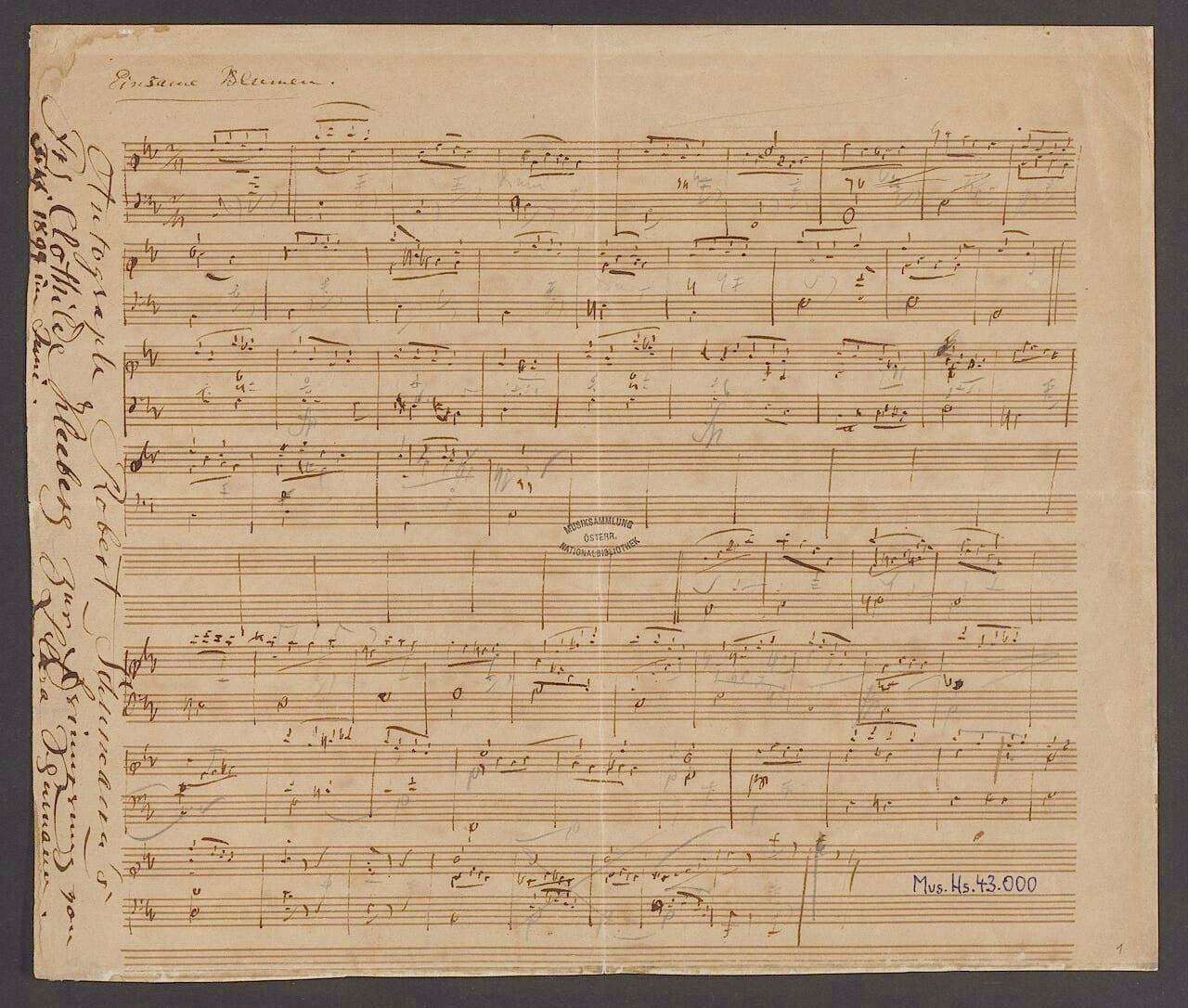
The chronological leap to the Waldszenen, Op. 82, allows us to gauge how profoundly the composer’s language had changed and, at the same time, how intact certain fundamental principles had remained. By now, one would hope, even the stones know that for the composer from Zwickau the Romantic forest is not simply a natural setting, but a symbolic territory, a space in which what appears outward ultimately comes to reflect a landscape of consciousness. Ergo, to enter the woods — an image that would be taken up a century later by Ernst Jünger in a political-philosophical key — is to enter a dimension in which familiarity and unease continually coexist.
Listening to Petrushansky’s reading, one can immediately grasp this shift in perspective. In Eintritt, the pianism becomes leaner, less feverish than in the works of the 1830s. The simplicity of the statement is not burdened with additional meanings: it is precisely its naturalness that creates the sensation of entering a different space. Yet already in Jäger auf der Lauer the landscape reveals its ambiguity, through a projection of rhythmic energy that is controlled with precision and accents that have real bite, without ever turning the hunt into a picturesque tableau. Einsame Blumen is even more revealing. Petrushansky adopts a restrained, inward tone, avoiding any overemphasis on the fragility of the piece, because Schumann’s “lonely flowers” do not call for sentimentality but for concentration; the sound must therefore remain simple, controlled, and, precisely for that reason, capable of acquiring a very particular intensity — something the Russian pianist and teacher fully conveys.
The dark heart of the cycle is, of course, Verrufene Stelle, the “haunted place.” Here the harmonic writing alone is enough to fracture any possible naturalistic serenity. Petrushansky therefore works more on density and colour than on overt dramatization. One hears this in the way the lower register possesses depth without opacity; the dissonances retain their corrosive power, and the silences themselves become part of the construction of tension. What does this mean? That the unsettling gravity saturating the piece is not simply represented: it is allowed to emerge.
But it is in Vogel als Prophet that our artist reaches one of the highest points of the entire recording project. Few pages in the whole of Romantic piano literature seem to gaze quite so far into the distance. The broken figures, the intervals, the sudden suspensions create a music that appears almost removed from historical time, from its objective representation, from its pervasive irradiation into the realm of space. The interpretative risk, at this point, would be to overemphasize its enigmatic character in programmatic terms, turning it into a kind of miniature Impressionist poem avant la lettre — in other words, a Debussy who rashly steps into a time machine and, by mistake, travels back several decades. Fortunately, Petrushansky takes the opposite path, for the simple reason that he manages to preserve an extraordinary precision of design while allowing the very strangeness of the writing to generate the mystery. He achieves this by keeping the resonances under control, carefully distinguishing the registers, and making the line seem to question the silence rather than merely emerge from it.
The concluding Abschied definitively confirms the coherence of the entire journey. This too is a farewell, but how different it is from the epilogue of the Davidsbündlertänze! There, it seemed as though a theatre of the soul were fading away; here, it is the landscape itself that recedes into the distance. This is why, quite rightly in my view, Petrushansky preserves an almost Classical sobriety, managing to convey this “farewell step” without turning leave-taking into elegy. Time flows naturally, the phrasing breathes, and the sound gradually withdraws, delicately and mournfully folding in upon itself. After passing through the forest, one returns to the world, but with a different awareness of what has been encountered there, because this page makes us perceive, in musical terms, something of that Heideggerian Lichtung: the sudden clearing in which light dazzles the wanderer before the path leads him once more into the protective half-shadow — at least as far as Dasein is concerned — cast by the interwoven branches that darken the way ahead.
At this point, the deeper significance of the repertoire choice emerges with complete clarity. We are not simply faced with four masterpieces of the piano literature brought together on a double CD, for with this programme Petrushansky has sought to trace, and to offer the listener, a genuine trajectory through Schumann’s consciousness. From the masks of Florestan and Eusebius we move to the circular form of the Arabeske, then to the great psychic labyrinth of the Humoreske, and finally to the projection of subjectivity into the landscape of the Waldszenen. Thus, for the benefit of our listening, we encounter the young Schumann staging his own inwardness, while the mature composer — already probing the approaching hour of darkness gathering within the mind — seems to recognize that inwardness in the world of things.
There is, moreover, another point that deserves emphasis after repeated listening to this double album: Petrushansky follows this trajectory without artificially altering his interpretative language from one work to the next, something many other pianists might have done, captivated and misled by the individual character of each score. On the contrary, his Schumann remains recognizable precisely because certain principles remain constant: clarity of voicing, control of weight, rejection of emphasis for its own sake, agogic freedom subordinated to syntax, attention to resonance, and, above all, the ability to conceive sound as part of a broader process of thought.
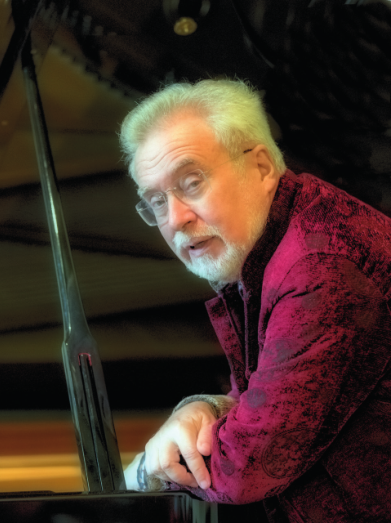
His is not a pianism that systematically seeks beauty of tone as an autonomous value; rather, it helps us understand that Schumannian colour always derives from the function of the phrase. Likewise, rubato never becomes an ostentatious gesture, but grows out of the breathing of the musical period and from the need to make the relationships among the different voices perceptible. In the more energetic passages Petrushansky is able to summon considerable power without hardening the sound — the sacred lesson of the Russian piano school — while in the more contemplative ones he avoids that haziness through which a certain conception of Romanticism sometimes ends up confusing profundity with indeterminacy.
What remains above all at the end of the listening experience, however, is the sense that we have witnessed not a succession of “character pieces”, but a long process of knowledge, an authentic Bildung in the Romantic sense of the word. And this is perhaps the most important achievement of Boris Petrushansky’s interpretation. Schumann is rescued both from the rhetoric of tormented Romanticism and from the temptation to reduce him to a sophisticated miniaturist. Rather, his music returns to what it most profoundly is: thought taking the form of sound while ceaselessly questioning itself.
Florestan and Eusebius, the inner voice of the Humoreske, the apparitions and distances of the Davidsbündlertänze, the shifting profile of the Arabeske, the forest of the Waldszenen — all ultimately belong to the same geography. They are different ways through which Schumann makes audible the life of consciousness which, under the pressure of an ever more insistent modernity knocking relentlessly at the door of time, is destined to become increasingly fragmented in human beings, like the splinters of a crazed mirror. Petrushansky does not attempt to explain all this to us. He does something far more difficult: he allows it to speak, to express itself, to reveal itself — a miraculous sonic epiphany.
On the strength of all this, this recording is MusicVoice’s Disc of the Month for October.
The depth of the interpretation is matched by a fine recording engineered by Roberto Passuti. The dynamic range, also as a consequence of the very close microphone placement — Petrushansky’s breathing is clearly audible and is an inevitable by-product of this choice — is exceptionally explosive and fast in its response, yet without revealing any signs of saturation, particularly in the upper and extreme upper registers. This also results in a relatively close reconstruction of the piano — a Steinway Model D — in terms of the soundstage. Even so, this choice does not lead to an incorrect or unnatural projection within the acoustic space, nor does it sacrifice the instrument’s natural resonance. The tonal balance and level of detail are also commendable. The former preserves clear separation between the upper register and the middle-lower range, thereby avoiding any timbral congestion, while the latter is reinforced by a convincing sense of acoustic blackness surrounding the instrument, allowing its image to emerge with a tangible three-dimensional presence.
Andrea Bedetti
Robert Schumann – Piano Works
Boris Petrushansky, piano
2 CDs – Da Vinci Classics Élus C01212
Artistic rating 5/5
Technical rating 4/5