Between the late nineteenth century and the early years of the twentieth, the world of the classical guitar experienced a kind of word-of-mouth, an imperative push to legitimize the instrument: until then, aided by an unfortunate and inadvertent tradition, its use had been confined to the drawing rooms of the rising bourgeoisie. The fact that the guitar had earlier, over time, progressively supplanted the lute—a dominant instrument from the heart of the Renaissance to the dawn of the Baroque—had certainly not helped it win a place among the noble instruments of the cultivated world of organized sound, especially since its repertoire could hardly aspire to the achievements reached by the piano, the violin, or even the cello.
The disabling factor that continued to marginalize the guitar was the conviction that its technical capabilities could not equal those of the instruments just mentioned; in short, the guitar could compete, but only in a “second division,” not in the “first division” of the European classical music scene. It is at this historical juncture—precisely in the turn-of-the-century transition—that performers, mainly in Spain, realized that if the guitar could and should aspire to promotion to the “first division,” this would only be possible if it proved that its technical peculiarities could be aligned with those of instruments already consecrated in the concert hall. Thus, to convince even the most reluctant purists with their noses in the air, musicians such as the Catalans Francisco Tárrega and Miguel Llobet and, needless to say, the Andalusian Andrés Segovia understood that the road to legitimizing their instrument had to pass through the art of transcription: having pieces originally written for instruments of the “higher category” performed on the guitar. This endeavour, pursued with tenacity and passion, indeed secured the longed-for promotion for the stringed instrument but, to stay with the sporting metaphor, once it reached the “first division” the guitar proved victorious almost always only in home games—that is, in transcriptions of works from the Iberian tradition—further entrenching the idea of a Spanish school whose raison d’être was to genuflect before the altar of the guitar.
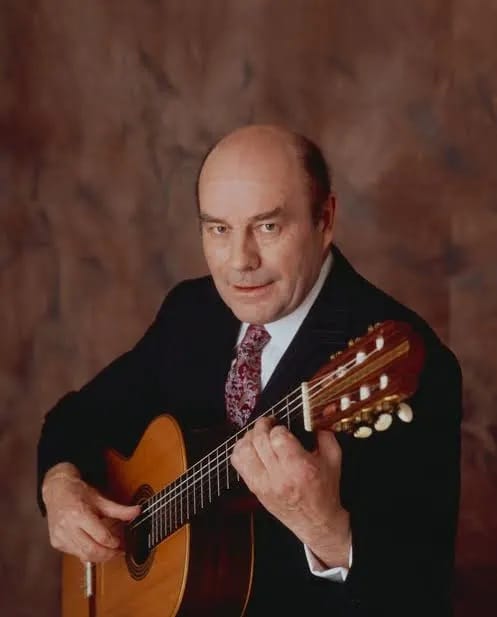
But to win championships and earn opponents’ respect you can’t just dominate at home and get routed on the road; so, during the twentieth century other guitar devotees emerged who understood that the difference would be made only by proving the guitar could do more than domestic transcriptions — by fully mastering composers and repertoires capable of traveling through time and space. Among the proponents of this vision and goal was the great English guitarist and, incidentally, lutenist Julian Bream, a true champion, through his tireless work of reassessment and dissemination, of what can be called the “guitar renaissance.” Thus, enough with the almost exclusively Spanish Romantic repertoire, enough with the usual association of the guitar with Iberian dance rhythms; instead, the instrument needed to be shown at ease with pieces ranging from the Renaissance — the era in which the lute reigned — to the engaged core of the twentieth century.
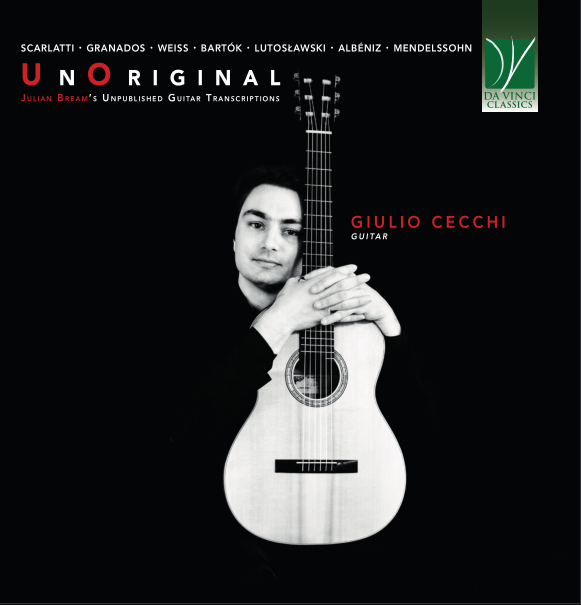
I believe the choice made by the young Florentine guitarist Giulio Cecchi, who has released his first CD on Da Vinci Classics titled UnOriginal. Julian Bream’s unpublished Guitar Transcriptions, in which he performs previously unpresented transcriptions by the great English guitarist, aims precisely to remind us that, before being remembered as one of the finest interpreters of the instrument, Bream’s name should above all be celebrated for his ability to turn into gold everything he touched — provided, of course, that it was done through his extraordinary gift for transcription and his sensitivity as an unsurpassed performer.
To demonstrate this, Cecchi drew on Bream’s transcriptions that range from Domenico Scarlatti to Witold Lutosławski, in a temporal and geographic sweep that, in chronological order, includes Sylvius Leopold Weiss, Felix Mendelssohn-Bartholdy, Isaac Albéniz, Enrique Granados and Béla Bartók — composers who, for the most part, had little or nothing to do with the guitar world. Now, apart from the Weiss piece presented by Cecchi — the famous Tombeau sur la mort de M. Comte de Logy, whose stylistic type written for lute is reflected in the guitar adaptation, even if the lower register’s range cannot be fully exploited, with the compensating advantage of greater melodic fluidity — the other pieces on the Florentine’s program more clearly reflect Bream’s transcriptive work, beginning with Domenico Scarlatti’s Sonata K.87, a piece written for the harpsichord or, more generally, for keyboard, which has long attracted the attention and fascination of guitarists. This was true for Segovia and also for Bream, who specifically transcribed this Scarlatti sonata for his instrument, shifting it from B minor to E minor to bring out the melancholic texture that permeates the work.
Starting from the key of E minor, which fits the guitar like a glove, Giulio Cecchi links to another transcription by the English musician: Mendelssohn’s Venetianisches Gondellied, that is, the Lied ohne Worte Op. 19 No. 6. Its evocative projection shifts the listener’s attention to the image of a gondola sadly rocking on the water’s surface, yielding a gently melancholic rhythm that is wonderfully exploited by the technical possibilities of the stringed instrument. The parallel journey between keyboard instruments—more precisely the piano—and the guitar continues with the two Spanish composers included by Cecchi on his disc: on one hand Granados with the Valses Poéticos, on the other Albéniz with two pieces, the fourth of the five that make up Cantos de España Op. 232, namely the famous “Córdoba,” and the second of the eight pieces forming Suite Española No. 1, that is “Cataluña.”
Let’s start with Albéniz: with “Córdoba” we are already primed by the composer from Camprodon’s own marginal suggestion on the score, which evokes an involvement of rhythms and nocturnal scents so typical of the Spanish musical culture of the time, steeped to the marrow in Romanticism—music that constantly tends to “evoke” and “represent.” This effect is further amplified by the shift from piano to the rhythmic sensibility of the guitar. With “Cataluña” the narrative fabric fixes on the concept of landscape, on a distinctly pictorial depiction; the guitar transcription subtly plays on timbral nuances that rhythmic changes can continuously provide, thereby completing what was originally created for the piano.
In the case of Granados’s Valses Poéticos, the transcription to guitar is the proverbial icing on the cake: the timbral palette ideally marries the instrument’s strings, which literally toy with the shifting rhythmic feel of the waltz time—here explored in many facets—and which the performer’s skill can exploit at the agogic level (a striking example is the third movement, the Vals lento).
So far it’s been a descent, but then there’s also an ascent, and this appears with the other two composers first taken up by Bream in transcription and then by Cecchi in performance: Béla Bartók and Witold Lutosławski. From Bartók the great English guitarist drew, respectively, from La Petite Suite, which anthologizes selections from the 44 Duets for two violins, and from Lutosławski the piano cycle Melodie ludowe (Folk Melodies). Thus, one must shift from nineteenth‑century horizontality to twentieth‑century verticality.
Bartók’s Kis szvit (Little Suite) for piano dates from 1936 and transcribes numbers 28, 32, 38, 43, 16 and 36 of the 44 Duets for two violins; therefore Bream’s is a transcription of a transcription, moving from two bowed instruments to the piano and finally to the guitar. Here the English master does more than transcribe: out of necessity (and because of the guitar’s limits) he must invent and create, working especially on the lower register, which must be continually fed and intensified in order to confront and converse with the middle‑high register.
For density, intensity and creative depth, I believe the high point of this recording is the cycle of twelve Melodie ludowe by Lutosławski, a composer entirely immune to the guitar’s traditional call. The didactic purpose of this cycle is reshaped, altered and filtered by Bream’s expert writing, who necessarily negotiates with the score, balancing weights and counterweights to preserve the rhythmic linearity that permeates the whole composition. The result is truly miraculous in its equilibrium, technical wisdom and expressive charge.
Of course, to debut on record with such a varied and demanding program is no small feat, but Giulio Cecchi has shown several very positive qualities: first, the passionate study he devoted to Julian Bream’s transcriptions, all held at the Jerwood Library of the Trinity Laban Conservatoire in London, to which Bream donated his scores; second, a technique always in the service of expressive inquiry—measured, thoughtful, never offered as mere virtuosic display—an additional tribute to Bream’s personality and artistic genius, who always regarded the art of transcription as a creative means in the same spirit that Bach cultivated the sacred concept of Bearbeitung. Finally, the beauty and allure of the sound the young Florentine guitarist manages to evoke (especially in the timbral nuances with which he shapes the pages of the Spanish composers).
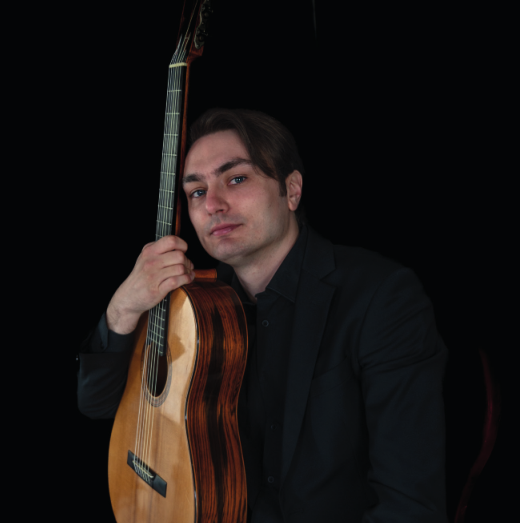
Once again Gabriele Zanetti has clocked in with an effective, realistic sound capture; the dynamics render the guitar’s timbre excellently (a 2008 Simon Ambridge model) thanks to abundant energy and speed, without the naturalness of the sound suffering from artificial colouring. The reconstruction of the soundstage places the guitar at a fair depth (the risk, with an overly exposed microphone, is having the guitar practically pressed against the listener’s cheek), allowing the surrounding ambience to be perceived, with the sound radiating sufficiently in height and breadth. The tonal balance shows no blotches or fraying, with the low and middle‑high registers always clearly distinguishable and never overlapping. Finally, the detail—rich and dark—gives a positive sense of materiality, making listening never tiring.
Andrea Bedetti
AA.VV. - UnOriginal. Julian Bream’s unpublished Guitar Transcriptions
Giulio Cecchi (guitar)
CD Da Vinci Classics C01136
Artistic rating 4/5
Technical rating 4,5/5