There are record projects, like the one examined here, that arise from the desire to symbolically link music to a specific image or to a distinct artistic or cultural concept. Images or ideas that strike the composers and are then rendered into sound or into corresponding “sonic visions.” It’s worth noting that classicism, in all its forms and facets, has long served as a rich reservoir of inspiration, ideas, and experimentation for the musical arts, not least because of the inexhaustible contributions of myths and their traditions, continually renewed over the centuries.
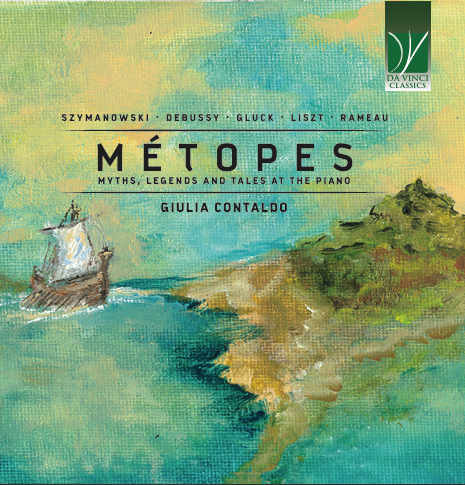
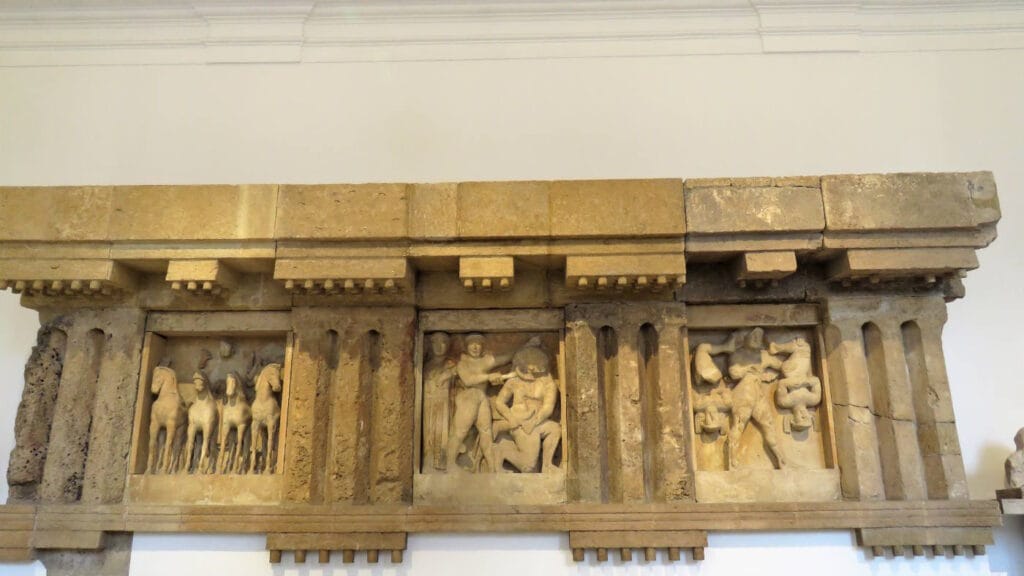
Among the concepts in classical culture that best embody and transmit the notion of myth is the one offered by the **metope**, the space between the triglyphs of a Doric frieze in ancient Greek architecture, which was often decorated—“filled”—with sculptural depictions of mythological scenes. In an era when written communication was still the preserve of a few, metopes functioned as a kind of three‑dimensional painting through which stories and legendary tales were told.
In a parallel move, the record at the centre of this review, aptly titled **Métopes. Myths, Legends, and Tales at the Piano** and released by Da Vinci Classics, features the young Italian‑American pianist Giulia Contaldo presenting seven piano pieces by six composers spanning a period from the Baroque to the late Romantic era. These pages draw directly on the evocative concept of the metope and on its powerful symbolic and expressive associations.
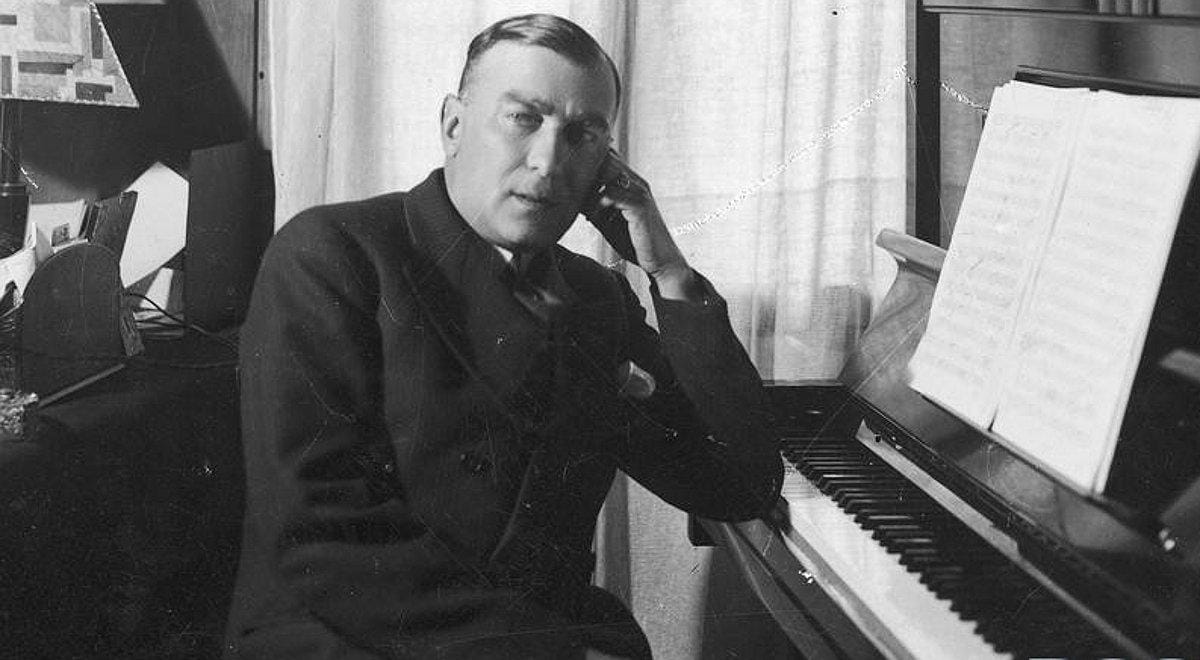
The composers and pieces chosen by the young pianist begin, following the playlist order, with the Polish composer Karol Szymanowski, born in Ukraine in 1882, who in 1914 wrote the piano triptych Métopes — “Trois Poèmes,” Op. 29, made up of L’île des Sirènes, Calypso and Nausicaa. Struck by a stay in Sicily during an extended tour of several European countries — a land rich in artistic and archaeological treasures, the last vestiges of Magna Graecia — Szymanowski was particularly moved, during a visit to the Palermo Museum, by certain metopes. The flash of inspiration those metopes provoked, together with the influence of reading Homer’s Odyssey, led the Polish musician to fashion, at the piano keyboard, a distinct timbral universe built through a constant balance of sonic weights and counterweights.
Calling it a timbral universe is no accident, since Debussy’s influence and lessons are unmistakable here. This is especially evident in the first two of the three pieces, where an emerging crystalline quality invites the listener to absorb a kind of motionless beauty meant to be contemplated by the ear. The narratives and memories the music evokes turn into a host of shifting, evanescent colours drawn from the triptych’s very titles, a clear inheritance of the Romantic tradition that treats music as a natural continuation of messages coming from other art forms. Listening to Métopes and considering the interpretive approach required to bring out its sonority, one cannot help but regret that a genius like Arturo Benedetti Michelangeli, particularly in light of “his” Debussy, never considered tackling the charm and magic of this triptych. From that observation one can also grasp another fact: the work’s difficulty is not only technical but, above all, expressive, demanding from any performer a continual search for a rarefied, diaphanous timbral touch, endlessly excavated, yet always keeping hold of the piece’s geometric dimension and overarching architecture, precisely because of that play of weights and counterweights mentioned above.
The link to the next “metope” is precisely Claude Debussy, whose famous page Prélude à l’après‑midi d’un faune Giulia Contaldo presents in the piano version by Leonard Borwick. Originally conceived for orchestra and freely inspired by Stéphane Mallarmé’s poem, Debussy’s piece is not easy to render on the piano: its timbral palette consists of a continuous flow of orchestral colour shifts that could easily dissipate in a keyboard arrangement. Fortunately, the meticulous and effective work of the British pianist preserves that richness, successfully conveying the esprit of the score, restoring a texture full of fleeting impressions and unfolding the poem’s narrative through an emotional tapestry of images and sensations.
It is obvious that a close relationship between image, narrative, and their sonic realization can rest primarily, as Debussy’s piece demonstrates, on the presence of a seductive melody that immediately seizes the listener. The same holds true for the next track on the Italian‑American pianist’s CD, a piano transcription by one of the architects of Italian late‑Romantic instrumentalism, Giovanni Sgambati, of the Melodia from Christoph Willibald Gluck’s Orfeo ed Euridice. Here the melodic theme is powerfully languid, following that crepuscular sensibility that permeated not only part of our literature of the period but also a significant slice of the bourgeois milieu of which the Roman composer‑pianist was an exemplary chronicler.
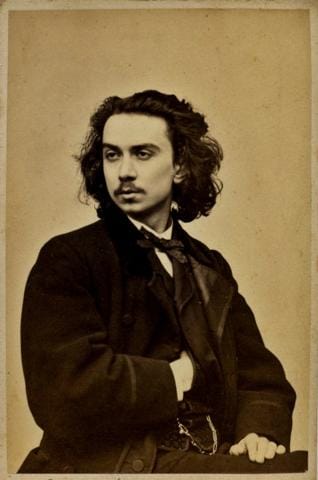
Giovanni Sgambati was, among other things, a fortunate pupil of Franz Liszt, and it is to that Hungarian genius that Giulia Contaldo performs two famous pages, plus a Wagnerian transcription: the first of the Two Legends, S.175 — the one dedicated to Saint Francis of Assisi, The Sermon to the Birds — and La Vallée d’Obermann from Années de pèlerinage (I — Suisse), while the transcription is the inevitable Isolde’s Liebestod from Tristan und Isolde. Admittedly, applying the metope concept to Saint Francis feels a little forced, since the saint belongs to historical reality rather than myth. Yet this particular piece (especially in its opening and closing sections) can, in a sense, be read as a precursor to what Olivier Messiaen would do in the twentieth century with his sonic investigations into birdsong, and the raw power that emerges from the dense pianistic fabric here seems like a genuinely exploratory device devised by Liszt.
The Années de pèlerinage piece also falls within the realm of sonic exploration, although in this case we are in very close contact with a literary subject that is literally lifted and placed on the piano keyboard — a move that could yield a crude or clumsy result, but when executed by Liszt becomes surgically perfect. Massive timbral forces are at play here: volumes that must be shifted instantaneously without upsetting the balance, roller‑coaster dynamics from fff to ppp, brushstrokes that in an instant leap from Jackson Pollock to Fra Angelico. In short, this is a work that is no joke technically or expressively, not least because everything must cohere from the first to the last note, with the piano assuming, en travesti, the contours of a compact orchestra, dehydrated and reconstituted on demand.
The final track on the program is a cameo of less than four minutes that nonetheless encapsulates the DNA of this recording project, transporting us to the heart of French Baroque — specifically Jean‑Philippe Rameau — with Les Cyclopes from the Pièces de clavecin. Beyond the fact that this collection sits surprisingly well with the “modern” timbre of the piano, the metope concept is clearly amplified by this piece, since it represents a genuine triumph of mythic storytelling seen through music’s delightfully distorting lens, especially when judged by the aesthetic standards of its time. In this piece devoted to the myth of the Cyclopes, Rameau manages to fuse two opposites so that they touch and fit together: the grotesque, embodied by the one‑eyed, gigantic Cyclops, and the sublime, produced by a keyboard writing that purifies, filters, and sweetens the horrific and the ugly into something that takes on the contours of wonder (here, the repeated notes of the instrument evoke the blacksmith’s hammer blows — the Cyclopes at their forge striking metal on the anvil).

Beyond the programmatic aims, I believe Giulia Contaldo intended with this recording to mark another milestone in her artistic journey: the acquisition of interpretive maturity on multiple levels. I venture this observation because I heard the Italian‑American pianist in 2022 at the Verona International Piano Competition (where she shared the second prize), and now, in light of this CD, one can say that much has passed under the bridges — and many more notes across the keyboard — meaning her process of assimilating and making the sonic material her own has inevitably sharpened. If technique once dominated her performance in Verona, today expressive stature and the relationship that forms between performer and piece — each work isolated in its absolute dimension — have reached parity with purely technical execution.
It is enough to listen to Giulia Contaldo’s reading of Szymanowski’s triptych: a successful outcome can only be achieved if the performer identifies not with the sonic material itself but with the idea of that material — in other words, with the indispensable ability to read beyond the staff.
The same holds for Debussy, who represents the unavoidable terminus of this identificatory process, where technique alone, however supreme, is never sufficient; Giulia Contaldo masters this also on an “imagistic” level with a “solid” liquidity, the adjective pointing to how the keyboard must allegorically transform into an orchestral element.
Of the three Liszt pages, I was especially convinced by the Wagner transcription, in which the Italian‑American pianist highlights the twofold dimension given by the eros/thanatos dilemma without ever succumbing to the temptation of inflating the overall vision with bombastic, contrived pathos. She maintains an emotional tension that is always well‑circumscribed — not, I would not say, “objectified,” but lucid and true to the work — also because Leonard Borwick’s arrangement tends to foreground (rightly, I would add) the ingenious harmonic component over the melodic one, the latter being a real trap for gullible performers.

I don’t mean to sound a cynical curmudgeon, but beyond the programmatic nature of this potpourri organized around the metope concept, it’s equally clear that Giulia Contaldo intended to demonstrate, on a purely pianistic level, that she has reached a higher rung: the ability to master entirely different styles, composers, eras and dynamics, traversing the centuries from the Baroque to the late Romantic with the effortless nonchalance that separates true interpreters from mere executants.
Excellent, comme d’habitude, is the sound capture by Gabriele Zanetti, who fully conveys the clarity of the Steinway Model D used by Giulia Contaldo thanks to dynamics that are at once rock‑solid and swift, free of inappropriate coloration. On the soundstage, the piano is placed convincingly at the centre of the speakers and set at a respectable depth, with a tone that radiates both upward and outward. Tonal balance and detail are also positive: the former respects the mid‑low and high registers, while the latter stands out for its material presence and three‑dimensionality.
Andrea Bedetti
AA.VV. — Métopes. Myths, Legends, and Tales at the Piano
Giulia Contaldo (piano)
CD Da Vinci Classics C00998
Artistic rating 4/5
Technical rating 4/5